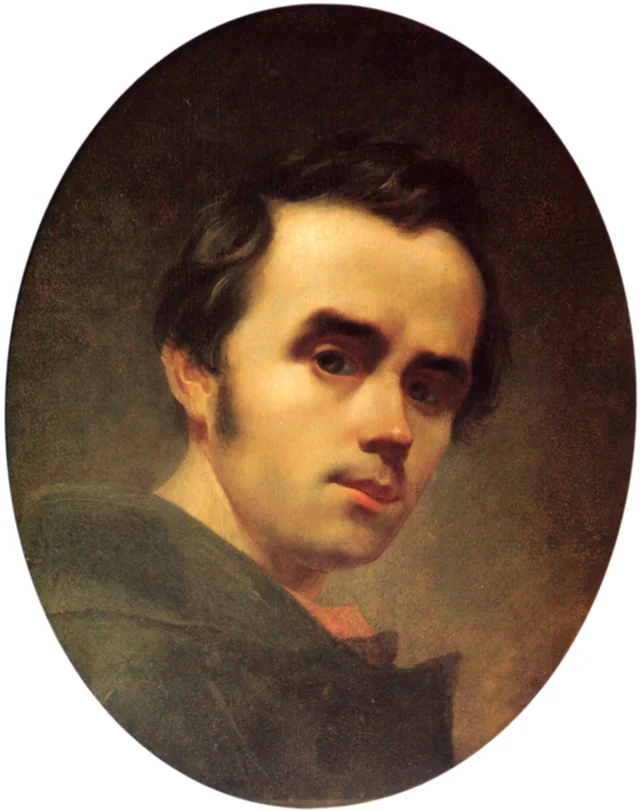
Taras Shevchenko
1814–1861 · Russian Empire · Romanticism
The story
Taras Shevchenko is the closest thing Ukraine has to a founding voice, the poet whose verse shaped the modern Ukrainian language and national feeling, and whose portrait still hangs in schools and town squares across the country. He is here among painters because before he was famous for his words he was trained for the brush, and he stayed a working artist all his life.
He was born in 1814 a serf, the legal property of a landowner, in a village south of Kyiv. His owner noticed the boy could draw and had him apprenticed to a decorator in St Petersburg. There his talent reached Karl Bryullov, the star painter of the Imperial Academy of Arts, and a circle of admirers hit on an unusual way to free him. Bryullov painted a portrait of the poet Vasily Zhukovsky, it was raffled in a lottery, and the 2,500 roubles it raised bought Shevchenko out of serfdom in 1838. He entered the Academy, won silver medals for his paintings, and years later was named an Academician of engraving.
The freedom did not last. In 1847 he was arrested for belonging to a secret Ukrainian brotherhood and for poems mocking the imperial family, and Tsar Nicholas I added a line to the sentence in his own hand, forbidding the prisoner to write or paint. Shevchenko spent 10 years as a common soldier in remote garrisons near the Caspian Sea, sketching the steppe and the Aral coast when no one was watching. He came home broken in health and died in 1861, at 47, the day after his birthday; a year later his body was carried to a hill above the Dnieper in Ukraine, where he had asked to be buried.