Culturawiki · CC-BY-SA-4.0
The Quattrocento in Rome and in Venice
Details
The story
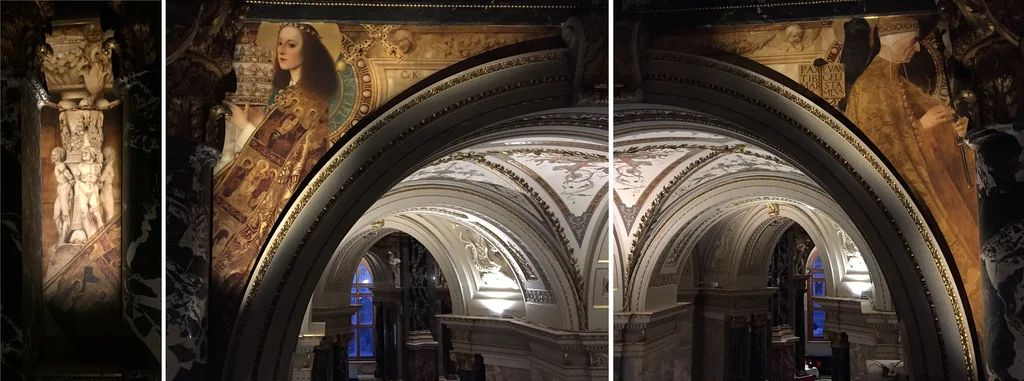
In 1890 and 1891, still in his twenties, Gustav Klimt worked with his brother Ernst and their partner Franz Matsch on the grand staircase of Vienna's new Kunsthistorisches Museum, filling the spandrels and the spaces between the columns with figures standing for the great periods of art. This section is the 15th century in Rome and in Venice, and each city gets its emblem. Papal Rome is a saint wrapped in splendid pontifical vestments, with a dark-haired young woman holding the papal tiara. Venice is a doge in the right-hand spandrel, and his face comes from a real painting, Giovanni Bellini's portrait of Doge Leonardo Loredan, now in London. He wears the ceremonial cap put on only for a doge's coronation and for state processions, holds a sceptre, and has the winged lion of Saint Mark behind his head. Between the columns Klimt even painted a holy-water basin, modelled on an early Renaissance one in Siena Cathedral. The panels were painted on canvas in the studio and then fixed to the staircase walls, where they remain.