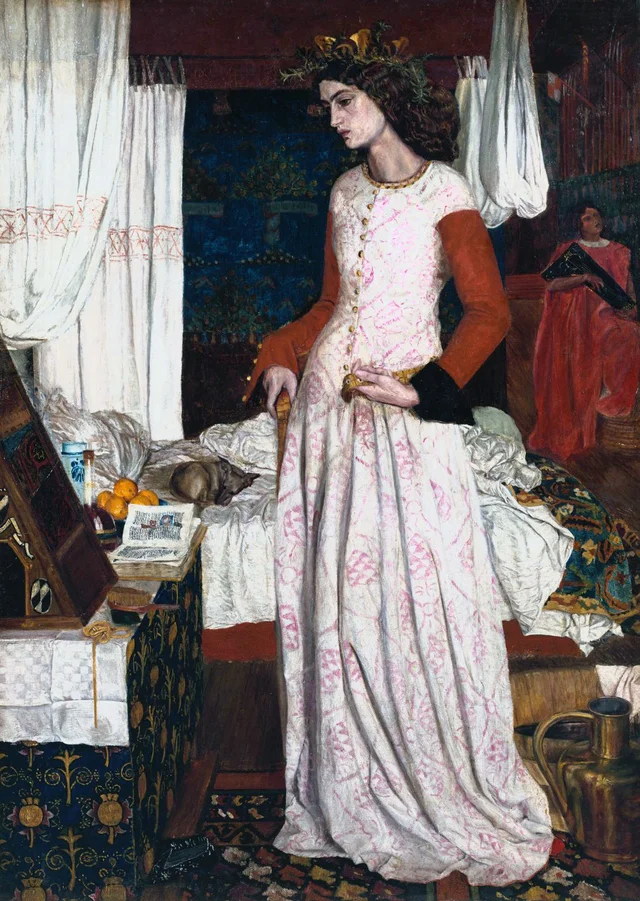
William Morris
1834–1896 · United Kingdom of Great Britain and Ireland · Arts and Crafts movement
The story
William Morris trained as an architect before deciding that Victorian industry had made ugliness and shoddy work the normal condition of everyday objects, and he set out to fix that directly. In 1861 he founded the decorative arts firm Morris, Marshall, Faulkner & Co. with the painter Edward Burne-Jones, the painter and poet Dante Gabriel Rossetti, and the architect Philip Webb, designing wallpaper, textiles, furniture, and stained glass by hand in deliberate defiance of mass production; renamed Morris & Co. in 1875, it became the signature look of tasteful English interiors for the rest of the century.
Design was not enough for him. In 1891 he founded the Kelmscott Press, printing books on a hand press with paper and type he designed himself, and its masterpiece, an edition of Geoffrey Chaucer's works illustrated by Burne-Jones, is still treated as one of the finest printed books ever made.
By the 1880s Morris had also become a committed revolutionary socialist, joining the Democratic Federation in 1883 and then, with backing from Karl Marx's collaborator Friedrich Engels, breaking away in 1884 to found the Socialist League. He saw the two halves of his life as one argument: honestly made things and a fairer society were, to him, the same cause, and he kept working at both until his death in 1896.