Jan van Eyck · PD
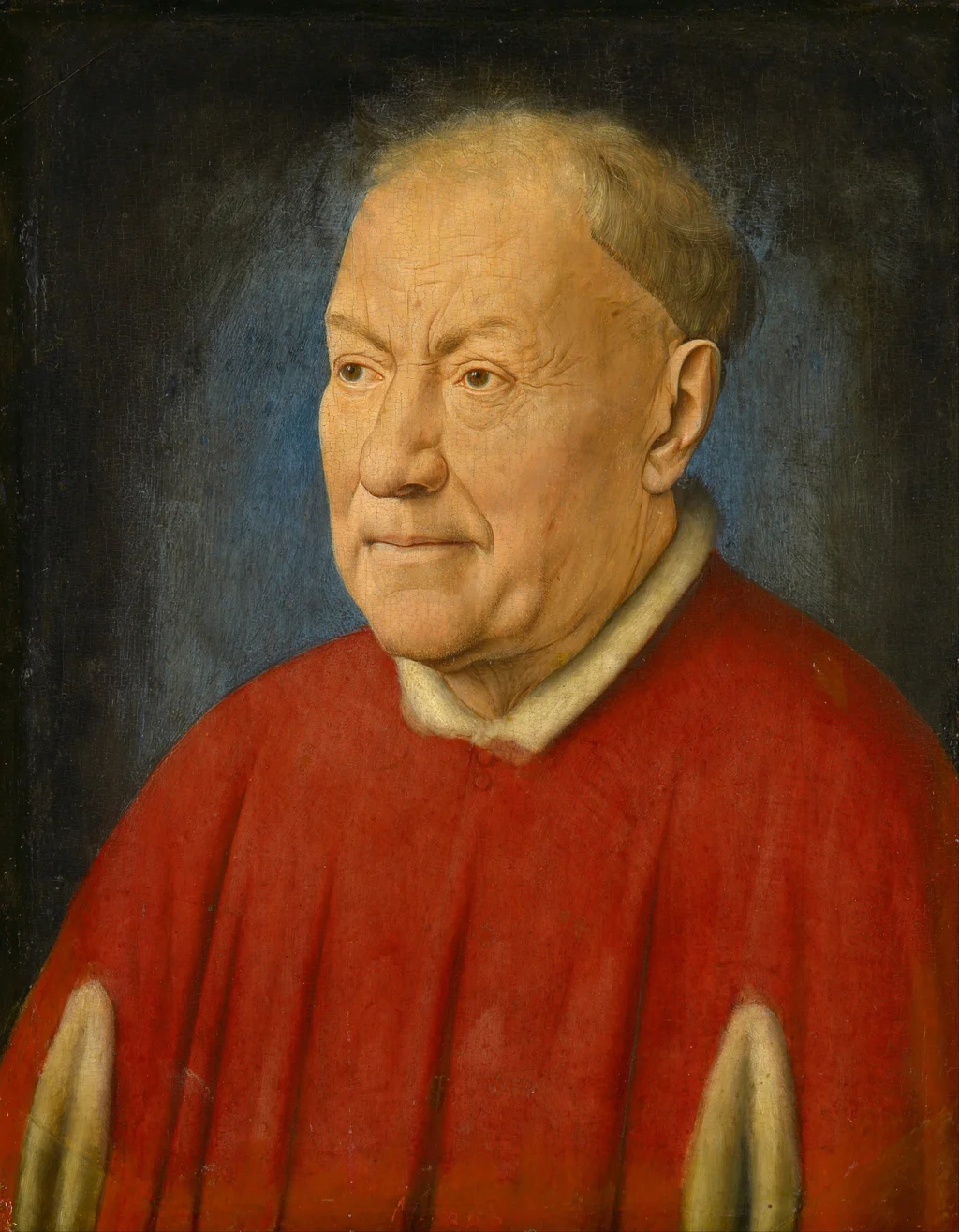
Portrait of a Man (Cardinal Niccolò Albergati?)
Details
The story
In 1435 the town of Arras filled with envoys, sent to make peace between the Duke of Burgundy and the King of France. Cardinal Niccolò Albergati came for the Pope. Cardinal Henry Beaufort came for the English. Jan van Eyck was the duke's painter, and whether the man in this portrait is either of them has never been settled. The name Albergati is not written anywhere on the panel. Archduke Leopold Wilhelm, the Habsburg governor in Brussels, bought it in 1648 from Pieter Stevens, an Antwerp dealer, and the name seems to go back to Stevens's time, two centuries after the painting was made. There is a problem with it. Albergati was a Carthusian monk, so he would have worn a tonsure and a religious habit. This man has short grey hair and lay clothes, a red robe trimmed with fur, with two slits at the front where the fur lining shows through. In 1990 the historian Malcolm Vale proposed Beaufort instead. The art historian John Hunter doubts the sitter was a cardinal at all. The Kunsthistorisches Museum now calls the picture a portrait of a man, puts a question mark after Albergati's name, and dates it around 1435, or perhaps 1438. Nobody disputes the face. Light falls from the upper left across the lined forehead, the pouches under the eyes, the grey stubble on the cheeks. A silverpoint study of the same head survives in Dresden. In the 18th century the panel was made into an oval, and it was later returned to a rectangle.