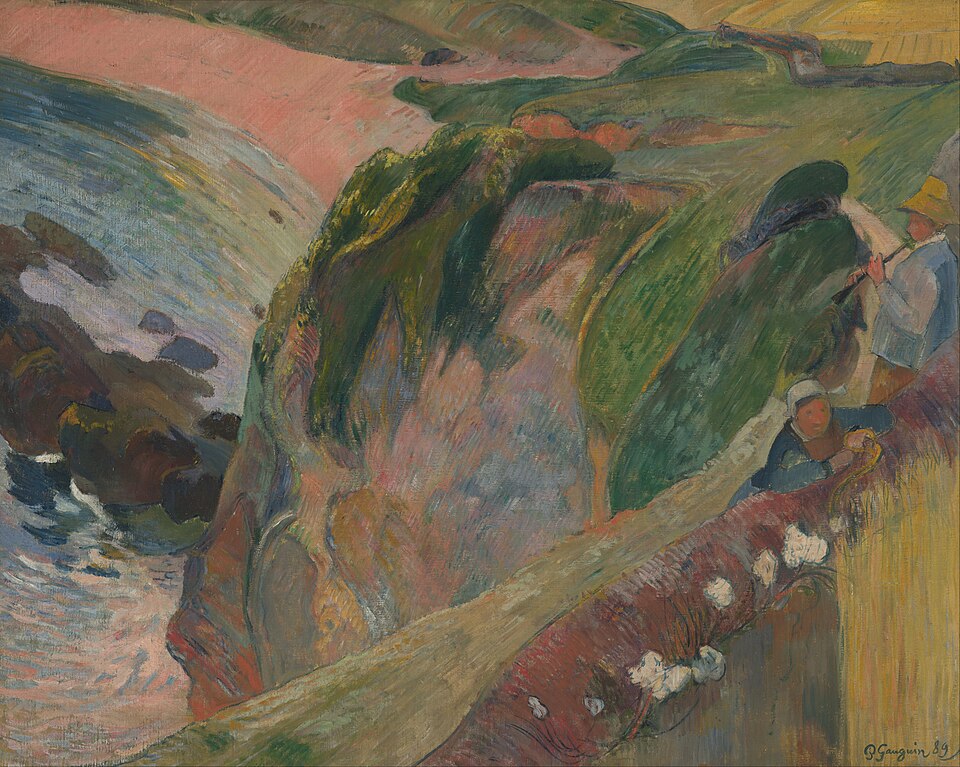
Paul Gauguin, The Flageolet Player on the Cliff, 1889. Wikimedia Commons. · PD
The Flageolet Player on the Cliff
Details
The story
Two years after Martinique, in 1889, Gauguin was back in Brittany, in the remote coastal village of Le Pouldu, where he and a small circle of painters worked out an approach they called Synthetism, flattening a scene into bold outlines and blocks of colour rather than copying every detail. On a narrow clifftop path a Breton boy plays a flageolet, a small local flute, while a girl stands by holding a scythe, the yellow patch below her the wheat she has come to cut. The high tilted ground and the way the sea sits like a wall behind them owe something to the Japanese prints Gauguin admired. It hangs in Indianapolis, part of a large group of Pont-Aven works the museum acquired in 1998.