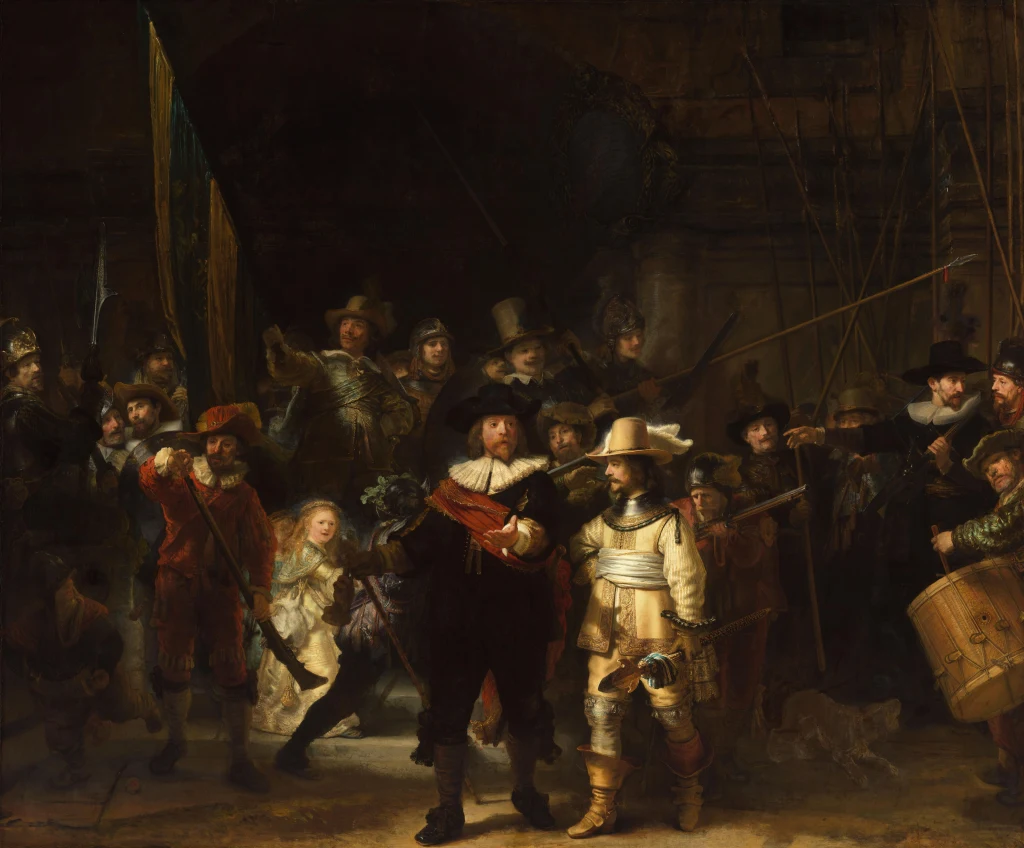
Rembrandt, The Night Watch, 1642. Wikimedia Commons. · PD
The Night Watch
Details
The story
The name has fooled people for centuries. This is not a night scene at all. When Rembrandt finished it in 1642, Amsterdam was rich and at the height of its golden age, and a civic militia company paid him to paint their group portrait for their hall. Each officer chipped in, and the amount you paid roughly decided how prominent you were in the picture. What Rembrandt gave them was not the usual tidy row of faces but a whole company caught mid-movement, spilling out of a dark archway into sunlight, the captain in black stepping forward and his lieutenant in bright yellow beside him. Over the next century the surface darkened under layers of varnish and soot until the daylight in it looked like torchlight, and that is when it picked up the name The Night Watch. The heavy varnish was only cleaned off in the 1940s. There is one more thing the crowd today does not see. In 1715 the painting was moved to Amsterdam's town hall and simply did not fit the wall, so it was trimmed on all four sides. The strip cut from the left took two figures and shifted the captain, who had stood a little off-centre, closer to the middle. Those trimmed pieces were never found.