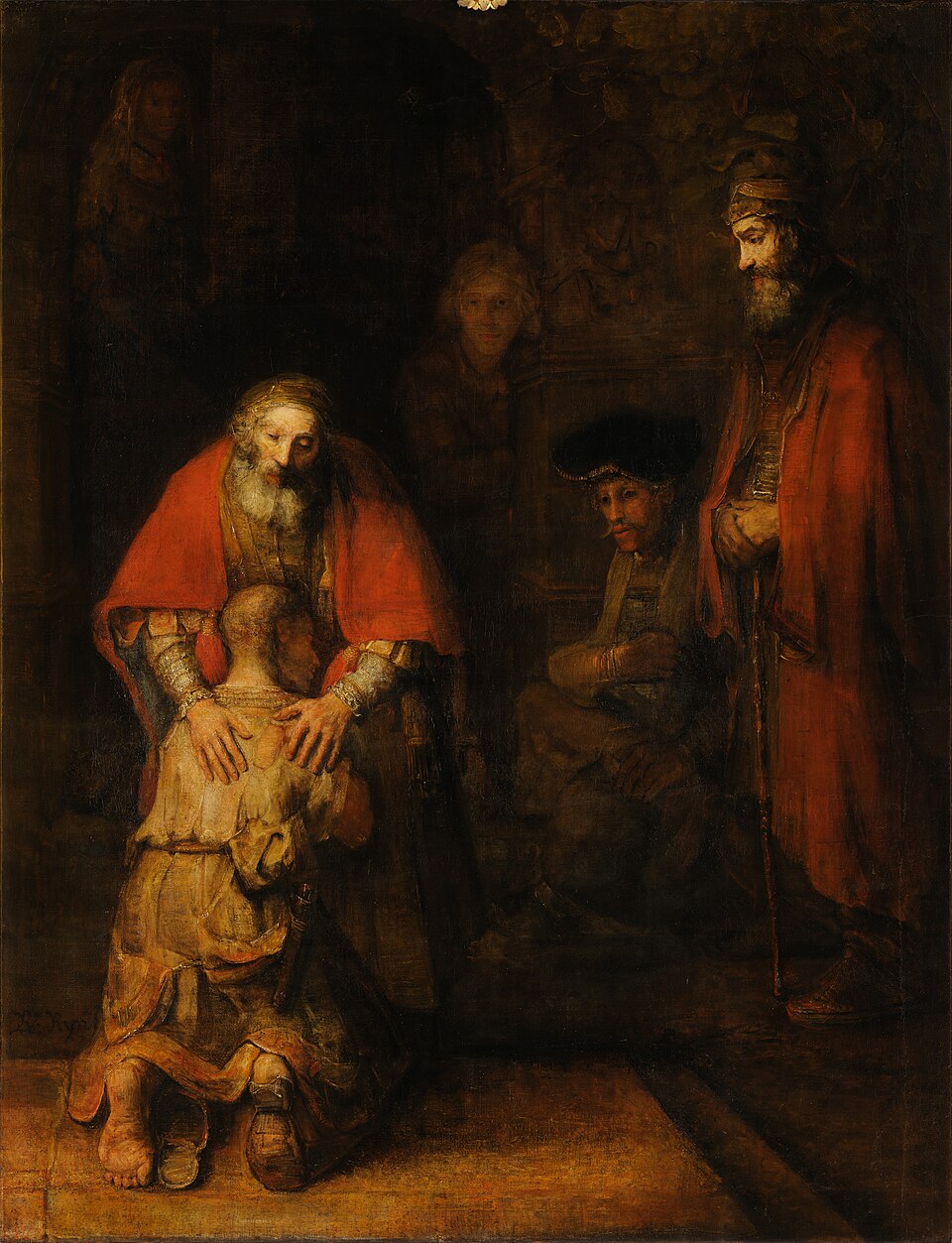
Rembrandt, The Return of the Prodigal Son, 1668. Wikimedia Commons. · PD
The Return of the Prodigal Son
Details
The story
Rembrandt painted this in the last year or two of his life, around 1668, and by then his world had mostly emptied out. He had gone bankrupt years before. His companion Hendrickje was dead, and in the autumn of 1668 his only surviving son Titus died too, still in his twenties. It is hard not to feel that weight in the picture. A ragged son kneels with his back to us, one shoe fallen off, his shaved head buried against his father's chest. The old man simply lays both hands on him. Look closely and the two hands are not the same, one broader and one more slender, as if a mother's touch were folded into the father's. Rembrandt made this huge canvas with no commission waiting for it, the light gathering only on the father, the son, and the silent watchers at the edge of the dark.