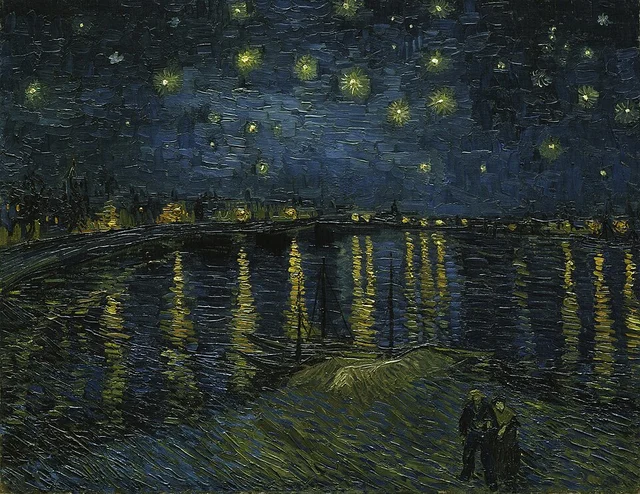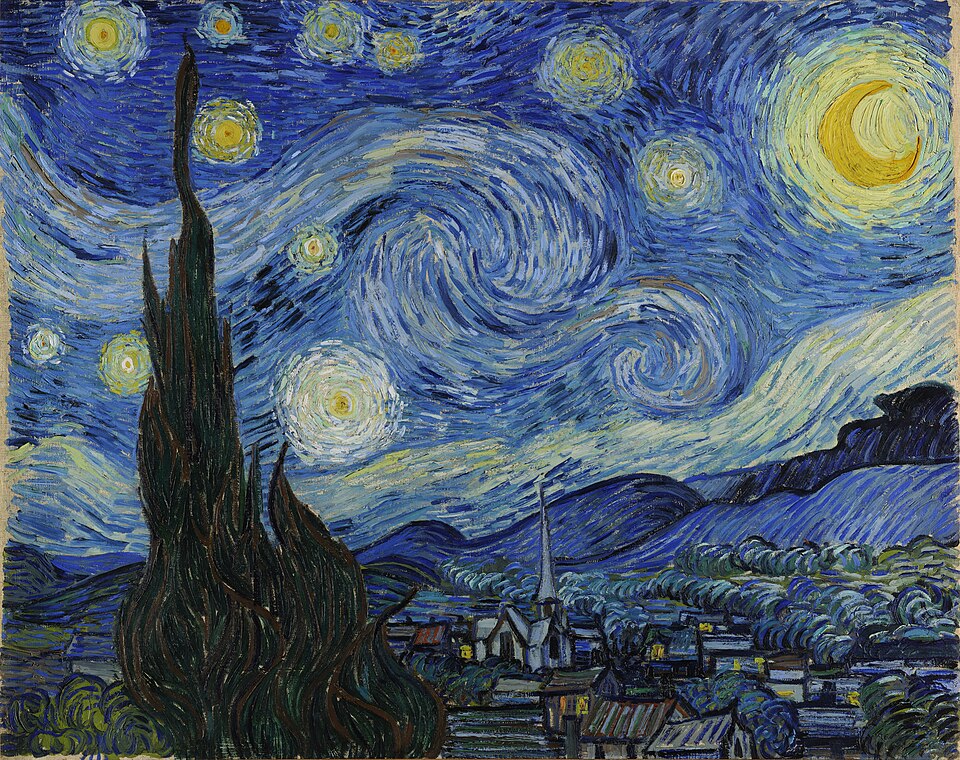
Vincent van Gogh, The Starry Night, 1889. Wikimedia Commons. · PD
The Starry Night
Details
The story
By June 1889 Van Gogh had been living for a few weeks inside the Saint-Paul asylum at Saint-Rémy-de-Provence, in the south of France, where he had checked himself in after the breakdown that cost him part of his left ear. From the barred window of his room he could see a stretch of countryside and, in the small hours, the sky. In a letter to his brother Theo he wrote that one morning, a long time before sunrise, he saw the country with nothing but the morning star, which looked very big. That bright point just to the right of the tall cypress is Venus, which really did hang low and brilliant over Provence that spring. Almost everything else he added or changed. He was not allowed to paint in his bedroom, so he worked this night scene downstairs, in daylight, from memory. The little village with its church spire is not really the view. He built it, spire and all, more like the towns of his native Holland than anything in the south. The swirling current running through the sky is his invention too, laid down in thick ribbons of paint you can still see standing off the surface. He thought of the picture as a study, a night effect he had been trying to catch for months, and told Theo it was rather a failure.