십자가 처형

Source: upload.wikimedia.org (operator-approved, non-displayable) · RESTRICTED

십자가 처형


상세 정보

제작 연도
1954
기법
캔버스에 유채
유형
회화
크기
58.4 × 73.7 cm

이야기

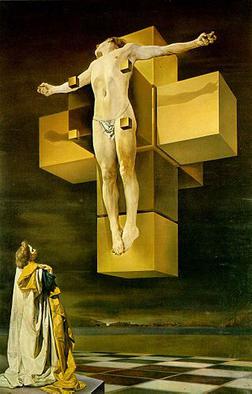
After the atomic bombs of 1945 Dalí announced that his new subject would be the marriage of physics and faith, and he began painting Catholic scenes charged with modern science. This crucifixion, from 1954, is one of his strangest. Christ hangs against a cross whose beams are the unfolded net of a four-dimensional cube, eight cubes opened flat into a floating shape of gold. There are no nails and no blood, and the body hovers just in front of the geometry rather than being fastened to it. Below stands a woman in gold looking up, modeled by Gala, Dalí's wife. The checkerboard floor beneath them is the courtyard of their house on the Catalan coast. Dalí gave the work a second title, Corpus Hypercubus, naming the shape directly. The Metropolitan Museum in New York acquired it the year after it was made.