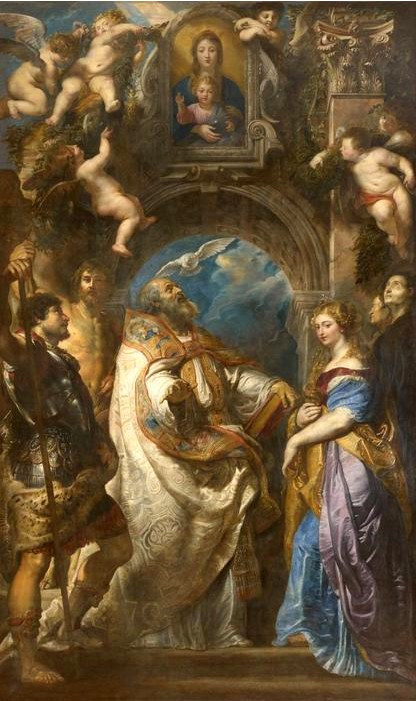
Peter Paul Rubens, The Madonna of Vallicella adored by St. Gregory with St. Maurus, and St. Papianus; St. Domitilla, with St. Nereus and St. Achilleus, 1607, 1606. Wikimedia Commons. · PD
瓦利切拉圣母,受到圣格里高利与圣毛罗、圣帕皮亚努斯的敬拜;圣多米蒂拉与圣内莱乌斯、圣阿基琉斯
作品信息
故事
In 1606 the young Peter Paul Rubens won the commission every foreign painter in Rome coveted. The high altar of the Chiesa Nuova, the church of the Oratorian order. He painted this large canvas, saints gathered around an ancient miracle-working image of the Madonna and Child. Then it failed, for a reason no one expected. Light glaring off the surface made the picture almost impossible to read where it hung above the altar. Rubens did not argue. He began again on slate, a dull dark stone that killed the reflections, and that second version stands in Rome to this day. The rejected first attempt he kept for himself, and it traveled with him out of Italy. It hangs now in Grenoble, in the French Alps, an altarpiece that never stood on an altar.