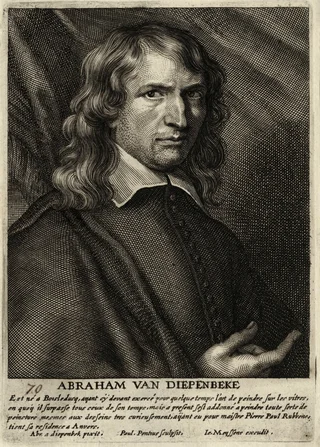
Abraham van Diepenbeeck
1596–1675 · Habsburg Netherlands, Dutch Republic · Baroque
The story
Abraham van Diepenbeeck was born in 's-Hertogenbosch in 1596, the son of a glass painter, and he began the same way, working on glass before he worked on canvas. He settled in Antwerp, joined the orbit of Peter Paul Rubens, the towering figure of Flemish painting, and absorbed his manner so thoroughly that he spent much of his career reworking Rubens's motifs into compositions of his own.
His real gift was invention on paper. Several hundred of his drawings and oil sketches survive, most of them made as designs for something else, a stained-glass window, an engraving, a woven tapestry. In 1655 he supplied a celebrated set of 58 mythological scenes for a French picture book known as the Temple of the Muses. And when William Cavendish, the exiled English Duke of Newcastle, wanted to publish his ideas on training horses, it was Diepenbeeck who drew the plates, showing the duke schooling his mounts before grand houses and formal gardens. That treatise, printed in Antwerp in 1658, became a famous manual of dressage, and the engravings made after his drawings are what most readers remember of it.