Abraham van Westerveld
1620–1692 · Dutch Republic · Dutch Golden Age, Baroque
The story
In 1651 a painter from Rotterdam was in Kyiv, drawing the Golden Gate, Saint Sophia Cathedral and the Pechersk Lavra, the city's great cave monastery. Abraham van Westerveld had come east as court artist to Janusz Radziwiłł, a commander of the Lithuanian army, and he followed him on campaign against the Cossacks during the Khmelnytsky Uprising, the revolt that shook the Polish-Lithuanian Commonwealth. His views of Kyiv, among them a panorama of the city seen from the northeast, are rare eyewitness images of how it looked in the middle of the 17th century.
By the end of 1653 he was home again in Rotterdam, and he stayed there for almost 40 years. He married five times, and in 1687 he became head of the city's guild of painters.
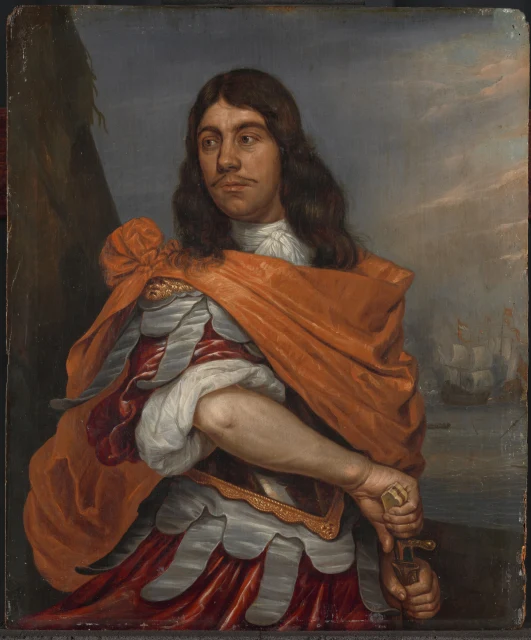
In the Rijksmuseum he is represented by a very Dutch subject. His small panel shows the admiral Cornelis Tromp, son of the famous admiral Maarten Tromp, dressed as a Roman commander. Tromp stands on a shore with a sea battle in the distance, drawing a karabela, the curved sabre of the Polish and Lithuanian nobility.