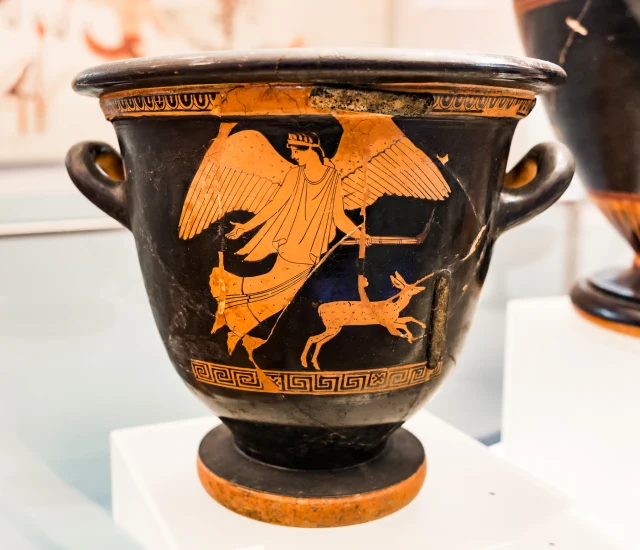
Achilles Painter
Ancient Greece · Classical Greek art
The story
In 447 BC Athens began building the Parthenon on the Acropolis, and for the next 15 years its sculptors worked towards a calm, idealised human figure. The Achilles Painter, a vase painter of the same generation, is often compared with that sculpture for the quiet poise of his figures and the restraint of his line.
His modern name comes from an amphora in the Vatican Museums, painted around 450 BC. On one side Achilles stands alone in full armour, one hand on his hip, the other holding a spear, and on the other a woman pours a libation. He was among the last pupils of the Berlin Painter, one of the leading painters of the generation before, and he passed the craft on in turn to younger men such as the Phiale Painter.
The Oxford scholar John Beazley gave him more than 200 vases, and the largest share are lekythoi, slender flasks for oil. The white-ground ones, painted on a chalky white coat in fine lines and soft colours, were made for the dead and placed at their graves, and Beazley called him the great master of the white lekythos. In 1962 one of them appeared on a Greek postage stamp.