Adam Elsheimer
1578–1610 · Holy Roman Empire · Baroque
The story
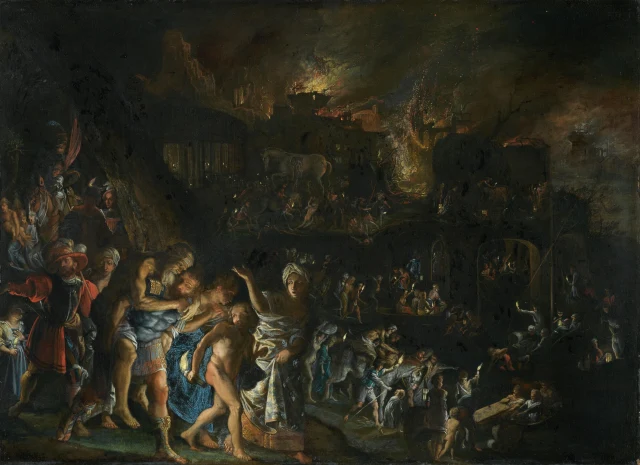
Adam Elsheimer left behind perhaps three dozen small pictures, most of them painted on sheets of copper no bigger than a book, and he was dead at 32. Yet painters far more famous studied him for a century.
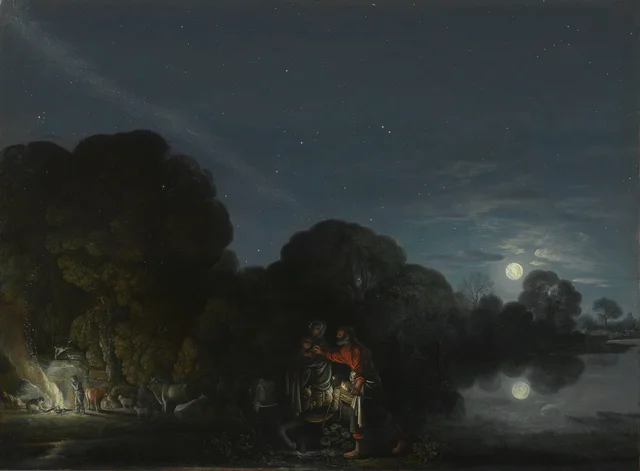
He worked in Rome, where he had settled around 1600, and his subject was often light in darkness: a fire, a candle, a moonlit road. His Flight into Egypt of 1609 shows the holy family walking under a real night sky, with the Milky Way rendered as a dense band of separate stars and the moon marked with shadowed craters. It was painted the year before Galileo published his telescope drawings, and it may be the first European painting to look at the heavens that closely.
When Elsheimer died in 1610, Peter Paul Rubens, the leading painter of the age, wrote from Antwerp that he knew no equal in small figures, and lamented the laziness and melancholy that had kept the output so thin. Rembrandt and Claude Lorrain both borrowed his handling of light for the rest of the century.