Adélaïde Labille-Guiard
1749–1803 · France · Rococo
The story
On the same day in 1783 the Académie Royale de Peinture admitted two women at once, Adélaïde Labille-Guiard and Élisabeth Vigée Le Brun, filling its self-imposed quota of four female members. The two were promptly cast as rivals, one linked to the king's aunts, the other the favourite of Queen Marie Antoinette, and the gossip of the period pitted them against each other for the rest of their careers.
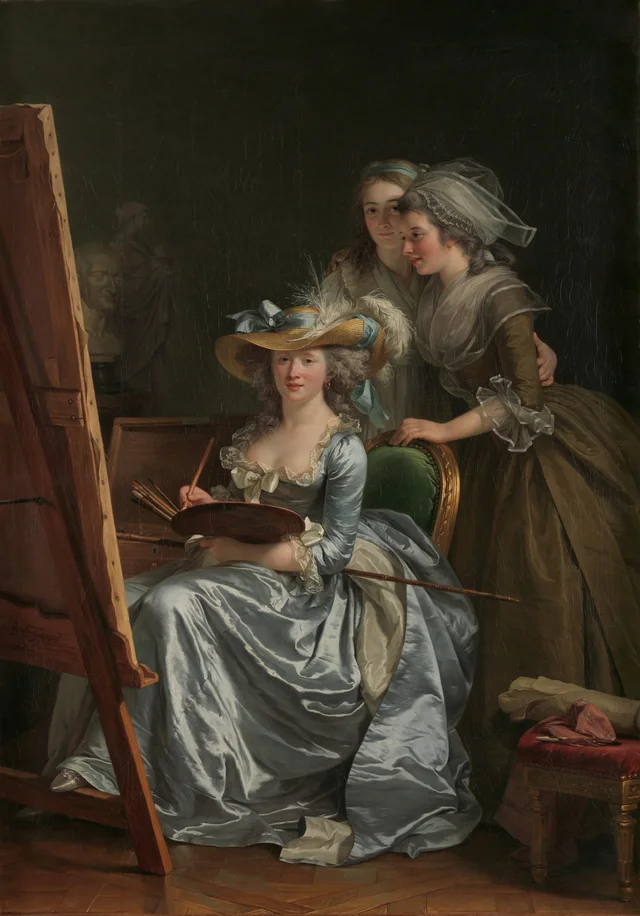
Labille-Guiard had trained first as a miniaturist and then as a pastellist under Maurice Quentin de La Tour, the great portraitist of the court, and her handling of pastel and oil was exact and unflattering in the best sense. Her Self-Portrait with Two Pupils of 1785 shows her at the easel with two young women behind her, and it was a deliberate argument. She took on female students and campaigned for the Académie to admit more women and to teach them properly.
The Revolution cost her. A large painting she had begun of the royal family was destroyed, and much of her court clientele scattered or went to the scaffold. She kept working through the upheaval, and in 1800 she won the right to live and exhibit in the Louvre, where studios were granted to artists. She died three years later, in 1803.