Adriaen de Vries
1626 · Habsburg Netherlands, Holy Roman Empire · Mannerism, Baroque
The story
In July 1648, in the last months of the Thirty Years' War, Swedish troops seized the castle district of Prague and shipped home the bronzes of Adriaen de Vries as war booty. Most of them are still in Sweden, in the park of Drottningholm Palace outside Stockholm, and the figures standing in Prague's Wallenstein Garden today are copies.
De Vries was born in The Hague around 1556, and by 1581 he was in Florence, working under Giambologna, the Flemish-born sculptor who led bronze casting at the Medici court. He took from him the twisting figure meant to be seen from every side, and pushed it toward looser, flickering surfaces and bodies caught in mid-movement.
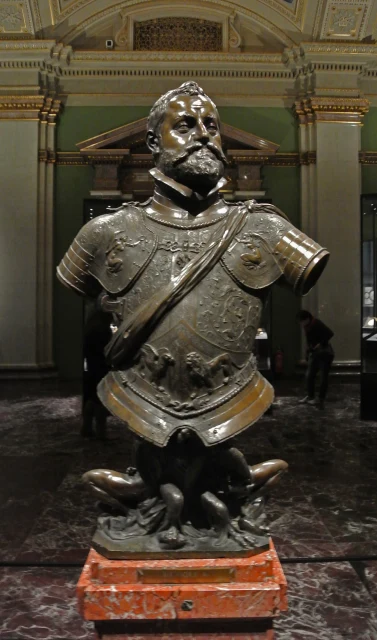
In 1601 Emperor Rudolf II, who filled his castle in Prague with paintings, instruments and curiosities, made him his chamber sculptor. De Vries modelled the emperor in busts and reliefs and cast mythological groups for his collection, and around the same time delivered two monumental fountains for the city of Augsburg. He stayed on after Rudolf died in 1612, working for princes across Northern Europe and finally for Albrecht von Wallenstein, the imperial general, who ordered bronzes for the garden of his new Prague palace. De Vries died in Prague in 1626.
One of his large commissions escaped the wars. The Resurrection group he made for the mausoleum of Prince Ernst of Holstein-Schaumburg at Stadthagen, in Lower Saxony, still stands in the chapel it was cast for.