Alejo Vera y Estaca
1834–1923 · Spain · Academic art, Romanticism
The story
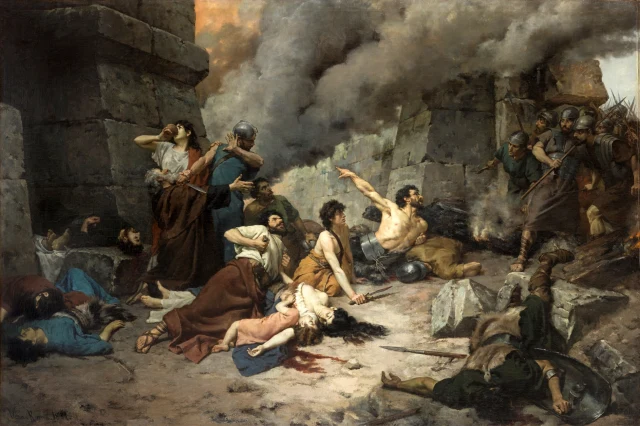
The painting Alejo Vera is remembered for is five metres wide and shows the last day of Numantia, the Celtiberian town that held out against a Roman siege in 133 BC and, by the ancient accounts, destroyed itself when it fell. He painted it in Rome. The signature in the lower left corner reads "A. Vera. Roma. 1881", and the Roman armour in it is generally traced to his study of Trajan's Column, the carved victory monument standing in the city where he worked.
He had reached Rome the ordinary way for a Spanish history painter of his generation. A grant took him to the San Fernando academy in Madrid, then to the studio of Federico de Madrazo, the court portraitist who ran the Prado, and then to Italy, where the ruins of Pompeii marked his work for good. He sent Numantia home to the National Exhibition of 1881 as the work of his third year on a state pension, and it took a first medal. From 1891 he directed the Spanish Academy in Rome, the residence the Spanish state keeps for its own pensioned artists, and he was later professor and secretary of the Escuela de Pintura, Escultura y Grabado in Madrid until he retired in 1919.
The canvas belongs to the Prado and has long hung on deposit with the provincial council of Soria, the province where the ruins of Numantia stand.