Alexandre-Évariste Fragonard
1780–1850 · France · Troubadour style, Neoclassicism, Romanticism
The story
In 1793, the year of the Terror, a boy of 13 had a drawing accepted at the Paris Salon. It showed Timoleon, the Greek general who let his own brother be killed rather than see him rule as a tyrant, and the boy was Alexandre-Évariste Fragonard, son of Jean-Honoré Fragonard, the painter of swings, stolen kisses and Rococo gardens. His father's playful manner was going out of fashion along with the old regime, and the son went on to study with Jacques-Louis David, the painter of the Revolution.
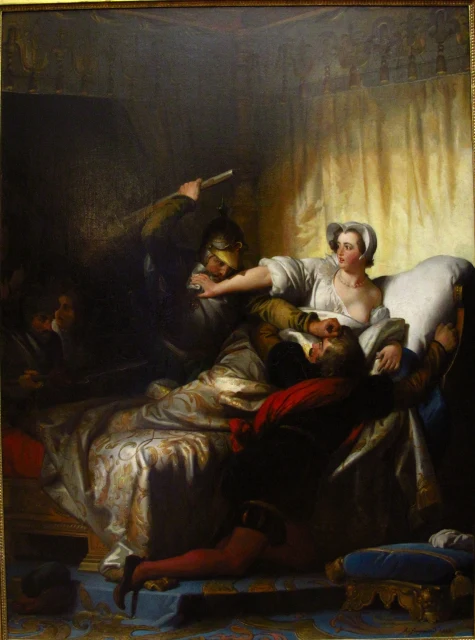
He kept something of both. Under Napoleon he painted grisailles, panels in shades of grey, for the Palais Bourbon, where the legislature sat. From around 1820 he turned to the French Middle Ages and Renaissance, the costume dramas later called the troubadour style, full of knights, kings and tapestried rooms.
His most visible work is on a ceiling of the Louvre. There he painted King Francis I with his court, receiving the paintings and statues that the Italian artist Primaticcio had brought back from Italy for the palace of Fontainebleau. He also carved sculpture, designed for the Sèvres porcelain factory and painted battles for the new history museum at Versailles, among them the victory of Marignano, finished in 1836.