Alois Schönn
1826–1897 · Austrian Empire, Austria-Hungary · Orientalism, Academic art
The story
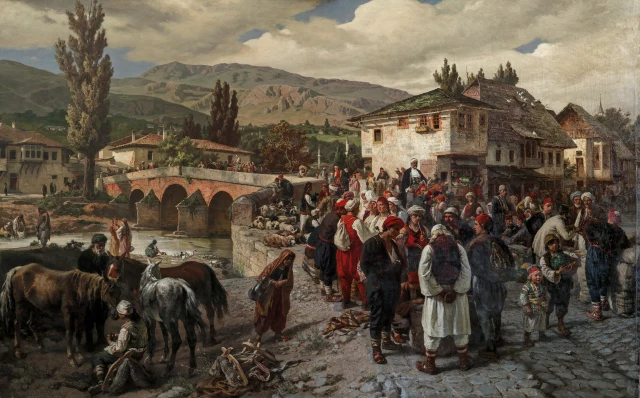
In 1878 Austria-Hungary occupied Bosnia, and Sarajevo, an Ottoman city for some four centuries, suddenly lay inside the Habsburg world. The Viennese painter Alois Schönn went there, and in 1883 he finished a canvas almost three metres wide showing the crowd at the Latin Bridge over the Miljacka river. It now hangs in the Belvedere. In 1914, 31 years later, on the street corner at the end of this same bridge, the heir to the throne Franz Ferdinand was shot.
Schönn was born in Vienna in 1826 and trained at the city's Academy of Fine Arts, first in engraving and then, from 1845, in history painting. Travel made his career. He went to Hungary, Galicia, Italy, France and Holland, and further east to Turkey and Egypt, and he specialised in oriental genre scenes, markets and street life. His work for the Vienna World's Fair of 1873 earned him the Order of Franz Joseph. After his death in 1897 he was given an honorary grave in Vienna.