Amasis Painter
Ancient Greece · Archaic Greek art
The story
Amasis was the Greek form of an Egyptian name, borne by a pharaoh who ruled in the middle of the 6th century BC and let Greek traders settle at Naukratis in the Nile Delta. In Athens in those same years a potter called Amasis signed his vases "Amasis made me". Twelve of the signed vases were painted by one hand, and since that painter's own name is lost, scholars call him the Amasis Painter. Whether potter and painter were the same man is still argued. Some see a single craftsman behind the distinctive shapes and the drawing, others prefer two partners.
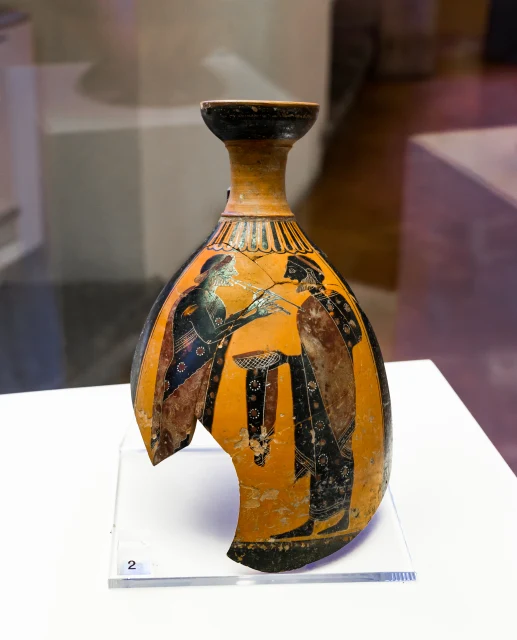
He worked from about 560 to 515 BC, the same years as Exekias, and the two are often set side by side. On a neck-amphora in Paris, found at Vulci in Etruria and signed twice by Amasis, two maenads with their arms around each other bring a hare to Dionysos. On a small oil flask in New York, women weigh wool, spin it and weave it at an upright loom.
His figures are precise and symmetrical, full of small details. In 1985 the curator Dietrich von Bothmer made him the subject of the first exhibition devoted to a single Athenian black-figure painter.