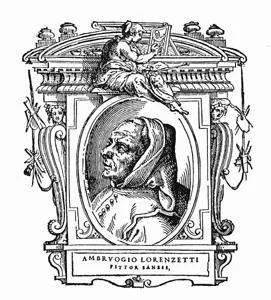
Ambrogio Lorenzetti
1348 · Republic of Siena · Sienese school
The story
In a council chamber in Siena, the room where nine merchants ran the city, Ambrogio Lorenzetti covered the walls with a lesson those men would face every time they sat down. On one side, good government, and a city that works: builders on the roofs, shops open, dancers in the street, wheat coming in from a peaceful countryside. On the other, tyranny, and the same city gone to ruin, its fields empty and soldiers loose in the streets. He painted it between 1338 and 1339.
To make the point he did something almost no one had attempted since antiquity. He painted a real, sprawling view of a town and the land around it, a wide panorama of Siena and its hills, so that the reward and the cost of rule felt like an actual place.
Ten years later the place itself was gutted. The plague we call the Black Death swept Siena in 1348 and killed perhaps half the city, Ambrogio among them, along with his brother Pietro, also a painter. The frescoes outlived them, and the personified figure of Peace still reclines on her cushion above where the nine once sat.