Analatos Painter
Ancient Greece · Archaic Greek art
The story
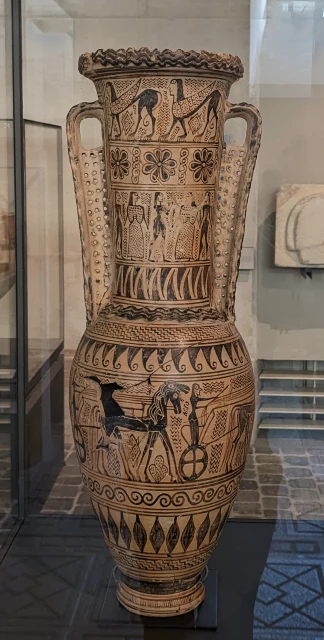
Analatos is a place, not a person. It was the old name of a district on the southern edge of Athens, today called Nea Smyrni, and several pots by one unnamed painter were dug up there. One of them, a water jar now in the National Archaeological Museum in Athens, became his name vase, and every work scholars recognise as by the same hand is credited to the Analatos Painter.
He worked around 700 to 680 BC, when Athenian potters were leaving behind the strict Geometric style, with its stick figures and bands of meander, for something looser that borrowed from the Near East. His earliest pots still look Geometric. Later he painted sphinxes, curling plants and rosettes, rows of dancing men and women, and processions of two-horse chariots, drawing bodies in solid silhouette but scratching details into the horses. Archaeologists call this phase Proto-Attic, and he is one of the earliest painters in it whose hand can be followed from pot to pot.