André Brouillet
1857–1914 · France · Academic art
The story
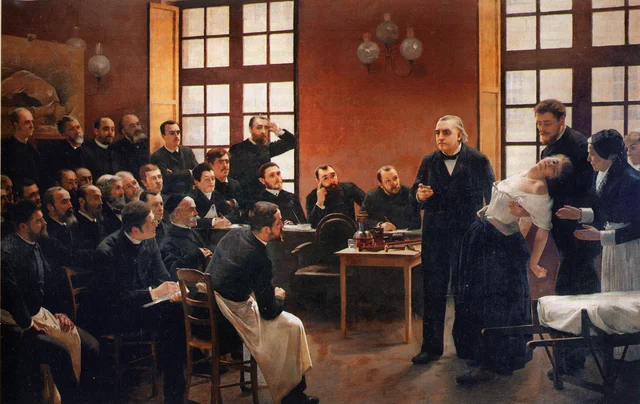
In a lecture room at the Salpêtrière, the vast hospital in Paris, a young woman sags backwards into the arms of a doctor while about 30 men in dark coats look on. Beside her stands Jean-Martin Charcot, the celebrated neurologist, and the woman is his patient Blanche Wittmann, shown in the grip of what doctors then called a hysterical attack. André Brouillet painted the scene on a canvas more than four metres wide and showed it at the Paris Salon of 1887.
Brouillet reached painting by a detour. The son of a sculptor from Charroux in western France, he first enrolled as an engineering student, then switched to the École des Beaux-Arts, where he trained under Jean-Léon Gérôme, the leading academic painter of the day, and later with the history painter Jean-Paul Laurens. The Salpêtrière picture made his name, and its faces are real portraits. The doctor supporting the patient is Joseph Babinski, whose reflex test is still used today, and Georges Gilles de la Tourette, who gave his name to Tourette syndrome, sits among the listeners.
After that his career ran along official lines. He painted portraits, genre scenes and landscapes, illustrated Victor Hugo and Guy de Maupassant, and in 1904 the women's magazine Fémina called him the painter of women. He received the Legion of Honour in 1906. A print of the Salpêtrière painting hung in the Vienna consulting room of Sigmund Freud, the founder of psychoanalysis, who had studied under Charcot, and after 1938 above his couch in London.