Andrea di Giusto
1400–1450 · Republic of Florence · Early Renaissance, Florentine school, Late Gothic
The story
In 1426 Masaccio, the young painter who was changing Florentine art, spent most of a year in Pisa on a large altarpiece for the Carmelite church there. The payment records for that job name his assistant, Andrea di Giusto, and scholars often credit Andrea with some of the small scenes along its base, among them the legend of Saint Julian and the charity of Saint Nicholas.
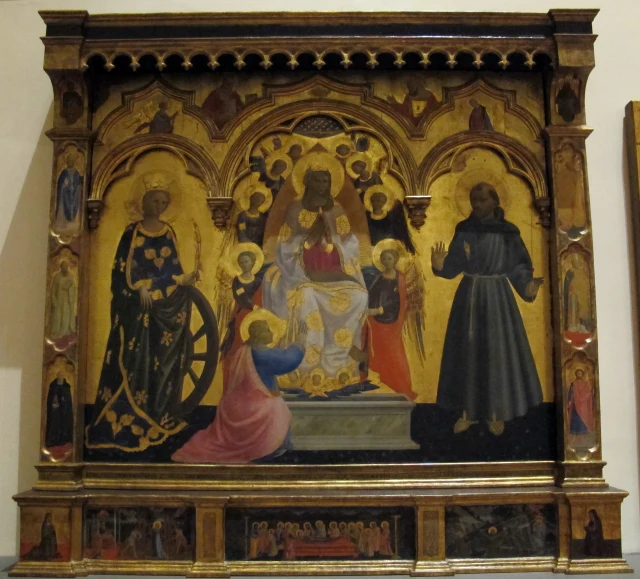
Andrea had started as a shop boy for Bicci di Lorenzo, a busy Florentine altarpiece painter, before going to Pisa. Back in Florence he set up for himself, and his pictures join Masaccio's solid figures to the gold grounds and patterned cloth his patrons still expected. His Madonna of the Girdle, dated 1437 and now in the Galleria dell'Accademia, shows the Virgin lowering her belt to the kneeling Saint Thomas, with Saint Catherine and Saint Francis beside her and her death told in the predella below. In the mid-1430s he is also credited with frescoes of the lives of the Virgin and Saint Stephen in a chapel of Prato Cathedral. He died in Florence in 1450, and his son Giusto d'Andrea became a painter too.