Andries Beeckman
1628–1664 · Dutch Republic · Baroque
The story
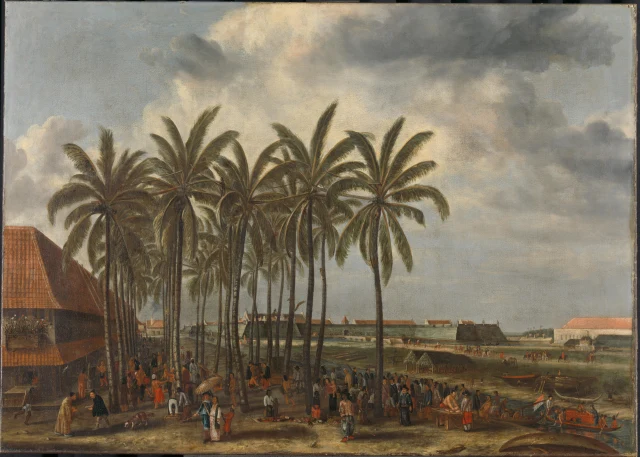
Andries Beeckman's big view of Batavia, today's Jakarta, puts a whole colonial town into one market square. Across the Kali Besar river stands the castle of the Dutch East India Company, the VOC, its headquarters in Asia. Beeckman shrank the river and left out buildings so that the fortress would show clearly.
In front of it, under tall coconut palms, he lined up the town's peoples almost like a catalogue of costumes. A Javanese woman sells fruit, a Chinese man fishes and Moluccans play football with a rattan ball. There are Mardijkers, formerly enslaved people recognisable by their striped clothes, and a Dutch-Eurasian couple followed by an enslaved servant holding a sunshade over them. Batavia was also the region's main slave market. The Rijksmuseum notes that all these people would never have been together at the same time.
Beeckman could paint them because he had been there. Baptised in Hasselt in 1628 and working as a painter in Deventer by 1651, he went east in the service of the VOC and was back from the Indies by the end of 1657, bringing watercolour albums of the people he had seen. From then on he specialised in Asian and African subjects. The Amsterdam chamber of the VOC ordered two paintings from him and paid 120 guilders for them in April 1662. This one hung in the company's East India House in Amsterdam, and the Rijksmuseum acquired it in 1859. Beeckman died in the city in 1664 and was buried in the Nieuwe Kerk.