Antoine Wiertz
1806–1865 · Belgium · Romanticism
The story
Antoine Wiertz made the young Belgian state an unusual offer. Give me a huge studio, he said, and I will fill it with paintings and leave them all to the nation. In 1850 the government agreed, built him the vast hall he wanted in Brussels, and after his death in 1865 inherited the contents. That building is now the Wiertz Museum, still hung as he left it.
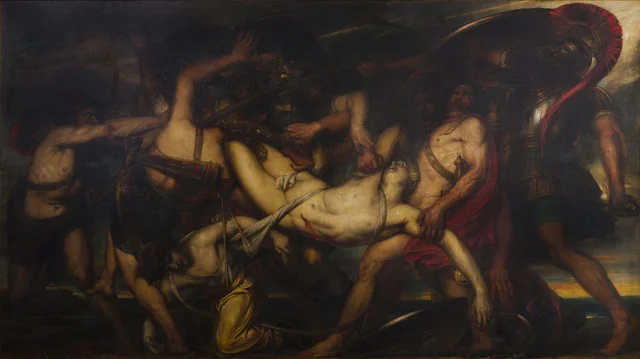
He needed the room because he painted enormous. His canvas of Greeks and Trojans fighting over the body of Patroclus, a scene from Homer, runs more than eight metres wide. Wiertz trained in Antwerp, Paris and Rome and worshipped Rubens and Michelangelo, and he genuinely believed he would outdo them.
Critics mostly laughed at him. What has kept his name alive is the darker, smaller work rather than the giants: paintings of premature burial, of a madwoman, and the unsettling picture usually called La Belle Rosine, in which a nude young woman stands face to face with a hanging skeleton labelled with her own name.