Anton Kolig
1886–1950 · Austria · Expressionism, Prague Secession
The story
In 1930 Anton Kolig and his students finished a cycle of frescoes in the Landhaus in Klagenfurt, the seat of the Carinthian provincial parliament. German-nationalist deputies demanded their removal the next year. The paintings were covered over in 1935, and after Austria's annexation by Germany in 1938 the Nazis destroyed them as degenerate art.
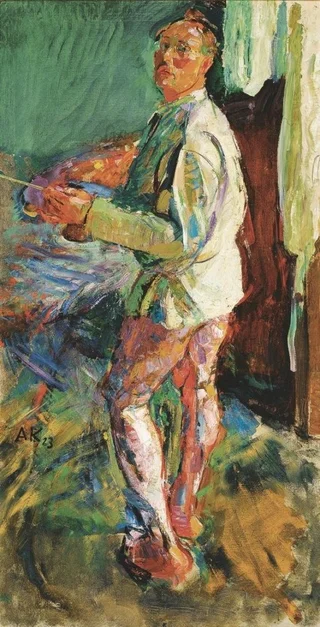
Kolig was born in 1886 in Neutitschein in Moravia, the son of a painter. He studied at the Vienna School of Applied Arts alongside Oskar Kokoschka, and in 1909 he joined Egon Schiele and other young painters impatient with the Academy in the New Art Group. The painters Gustav Klimt and Carl Moll helped him to a travel grant for France, and the outbreak of war in 1914 caught him in Marseille. From 1917 he served as an official war painter.
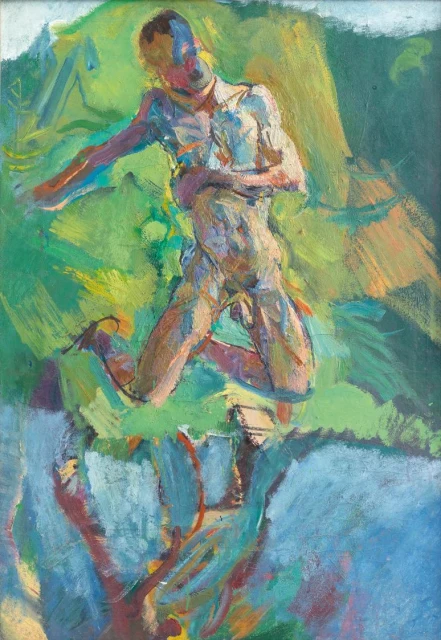
His home became Nötsch, a village in the Gail valley in Carinthia and the home of his friend, the painter Franz Wiegele, whose sister he married. The artists around them are known as the Nötsch Circle. Kolig painted portraits and, above all, the male nude, like the Belvedere's Kneeling Narcissus of 1920. In 1928 he became a professor at the Stuttgart Academy, and in 1943 he was forced into retirement. A bombing raid in December 1944 buried him and his wife under rubble, and both were badly injured. He died in Nötsch in 1950.