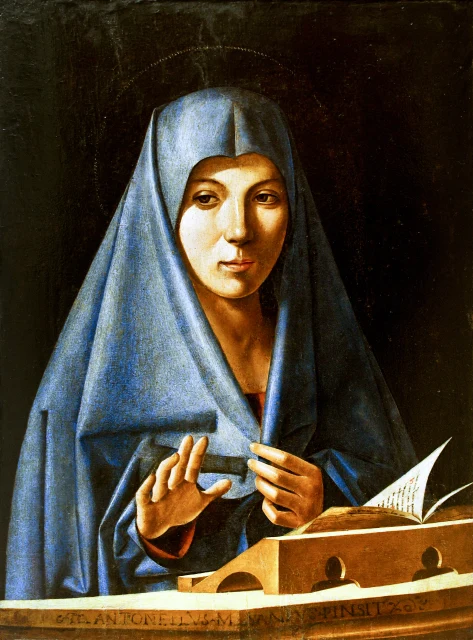
Antonello de Saliba
1466–1535 · Kingdom of Sicily · Renaissance, Sicilian school
The story
When Antonello da Messina died in 1479, he left Sicily something rare: a way of painting in oils, learned from Netherlandish pictures, that gave faces a still, glassy life unlike anything else in the south. Keeping that manner alive fell largely to his family, and Antonello de Saliba was part of it.
He was the master's nephew, born in Messina around 1466 into a household of woodcarvers and painters. As a boy he was apprenticed to his cousin Jacobello, Antonello's son, and with him he seems to have travelled north to Venice, where the Messina style had already made its mark and where Giovanni Bellini's busy workshop was close at hand.
Back in Sicily and Calabria he spent his career repeating and adapting the family formulas — small devotional Madonnas, half-length saints, the calm Antonellesque light — for churches across the island. Historians group him with the 'antonelliani', the painters who carried that inheritance into the 16th century. A Virgin and Child he signed in 1497 is among the works securely his.