Antonín Procházka
1882–1945 · Czechoslovakia, Austria–Hungary · Expressionism
The story
In the summer of 1938, as the crisis with Germany deepened, Antonín Procházka and his wife, the painter Linka Procházková, were covering an entire wall of the law faculty at Masaryk University in Brno. The subject was Prometheus bringing fire to mankind, on a canvas about 7.5 by 13 metres. It was unveiled on 16 December 1938, weeks after the Munich Agreement had handed Czechoslovakia's border regions to Germany, and it still fills the front wall of the faculty's great hall.
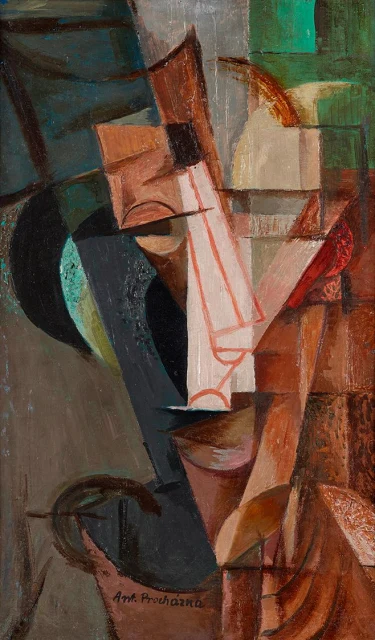
Procházka reached that classical Prometheus by a long road. In 1907 he was one of the Eight, a group of young Prague painters that included Emil Filla and Bohumil Kubišta, who took their cue from Edvard Munch and the French Fauves. A few years later he turned to Cubism, and in 1913 he showed a Cubist still life in Berlin at the First German Autumn Salon, the big avant-garde exhibition of that year. The Belvedere's Man's Head also dates from 1913.
From 1924 he taught drawing in Brno, and after the mid-1920s his painting grew calmer and more classical, full of figures and myths from antiquity. During the German occupation he illustrated the folk ballads of Karel Jaromír Erben, a 19th-century Czech poet, and made small equestrian statuettes of the republic's first president, Tomáš Masaryk. He died in Brno in June 1945, weeks after the end of the war.