Antonio Campi
1524–1587 · Duchy of Milan · Late Renaissance, Mannerism
The story
In 1571 Antonio Campi drew a map of Cremona so useful to the city that the council exempted him from its taxes. Fourteen years later he published the place entire, Cremona fedelissima, a folio history dedicated to Philip II of Spain, who then ruled Lombardy, with engraved plates and portraits cut by the young Agostino Carracci.
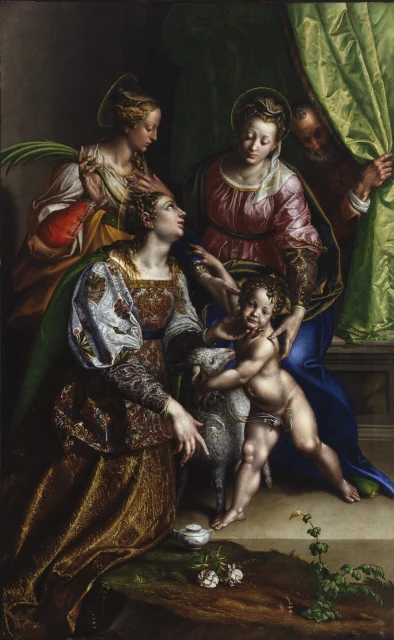
Painting was the family trade. His father Galeazzo and his half-brother Giulio kept the busiest workshop in Cremona, his younger brother Vincenzo worked in it too, and Antonio's first documented picture dates from 1546. The altarpieces went into the churches around him, a Pietà of 1566 for Cremona Cathedral among them. What later painters remembered was the lighting. His Beheading of John the Baptist of 1571, in the Milanese church of San Paolo Converso, sets the execution in a dark room broken by a single torch, and Roberto Longhi, the historian who reassembled Caravaggio's career in the last century, called that picture an essential precedent for him. Caravaggio was born in 1571 and served his apprenticeship in Milan.
From 1580 Campi was architect to the works at Cremona Cathedral, and Pope Gregory XIII knighted him in 1583 for that side of his work. He died in January 1587, leaving a house with a library of some 6,000 volumes in it.