Antonio Corradini
1688–1752 · Republic of Venice · Baroque, Rococo
The story
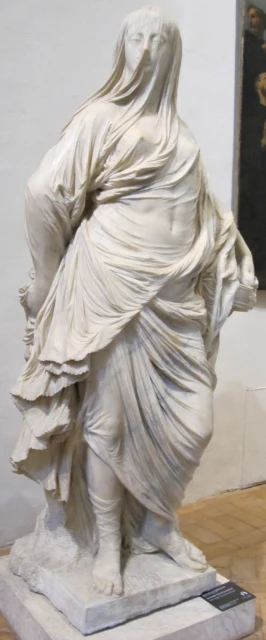
In August 1752 Antonio Corradini died suddenly in Naples, in the middle of the biggest job of his last years. He was making the marble figures for the family chapel of Raimondo di Sangro, Prince of Sansevero, and among the things he left behind was a clay model of the dead Christ lying under a shroud. The commission passed to the Neapolitan sculptor Giuseppe Sanmartino, whose Veiled Christ, finished the following year, is now the chapel's best-known work. Near it stands a figure Corradini did finish, Modesty, a woman wrapped in a veil so thin that the body shows through.
Veiled women had been his speciality since his late twenties. A Venetian, born in 1688, he trained in the workshop of the sculptor Antonio Tarsia and made his name with marble for foreign rulers: statues and busts for the Summer Garden of the Russian tsar Peter the Great in Saint Petersburg, mythological groups for the gardens of Augustus the Strong, Elector of Saxony, in Dresden. At home he oversaw the rebuilding of the Bucintoro, the doge's ceremonial barge. From 1733 he was court sculptor in Vienna to Emperor Charles VI. In the early 1740s he moved to Rome, where for a time he shared lodgings with the young Venetian engraver Giovanni Battista Piranesi.