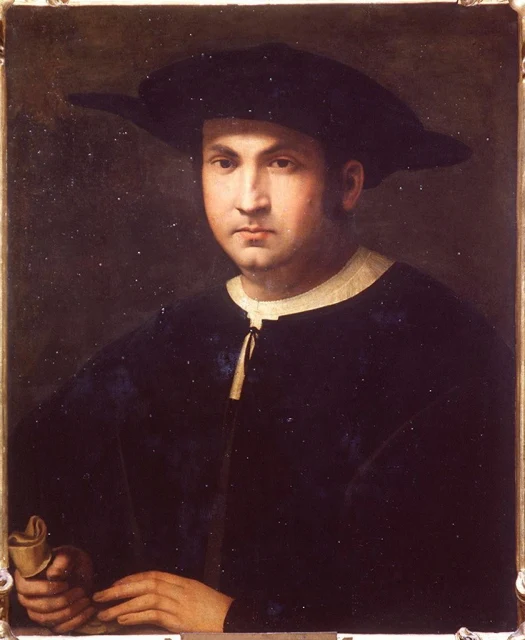
Antonio del Ceraiolo
Republic of Florence, Duchy of Florence · Italian Renaissance
The story
The portrait of a man in the Palatina gallery at Palazzo Pitti has been catalogued under four different names without anyone touching the panel. A Medici inventory of 1675 listed it as an Andrea del Sarto. In 1815 the inventory made it a Pontormo, and by 1829 it had slipped to the school of Andrea del Sarto. The name on it now, Antonio del Ceraiolo, was proposed by the connoisseur Carlo Gamba, and Federico Zeri, who spent a career cataloguing Italian painting, accepted it with reservations, adding that the picture also resembles the work of another Florentine, Tommaso di Stefano.
That reshuffling is ordinary for a painter who left almost no paper behind. He was born Antonio di Arcangelo, and the nickname came from his father's trade of making candles. He is documented in Florence across the first half of the 16th century and no more precisely than that, with no agreed birth year and no agreed year of death. Vasari, writing a generation later, says he trained first under Lorenzo di Credi and then in the crowded workshop of Ridolfo del Ghirlandaio, and singles him out for portraits.
Most of what survives under his name is devotional work for the home, half-length Madonnas with the Christ Child and the young Saint John the Baptist, the patron saint of Florence. The two altarpieces Vasari named are still in the city, in the museum of the Cenacolo di San Salvi, a Crucifixion with Saint Francis and Mary Magdalen and a Saint Michael painted for the church of Santissima Annunziata.