Antonio Puccinelli
1822–1897 · Grand Duchy of Tuscany, Kingdom of Italy · Academic art, Macchiaioli
The story
In 1852, on a fellowship in Rome, Antonio Puccinelli painted people out walking below the Muro Torto, the leaning stretch of ancient city wall where Romans took the air. He built it out of abrupt blocks of light and shade, the shorthand painters normally kept for oil sketches, used here on a finished picture. Italian critics later pointed at that canvas as an early sign of the macchia, the patch of tone that gave the Macchiaioli their name, and the writer and collector Ugo Ojetti owned it.
Puccinelli had arrived there by an unlikely road. Born at Castelfranco di Sotto in 1822, he was first taught his father's trade of tailoring, and local patrons who noticed his likenesses paid for his place at the Florence academy in 1839. After Rome he settled into the establishment, a professor in Florence from 1855 and holder of the painting chair at the Bologna academy from 1861.
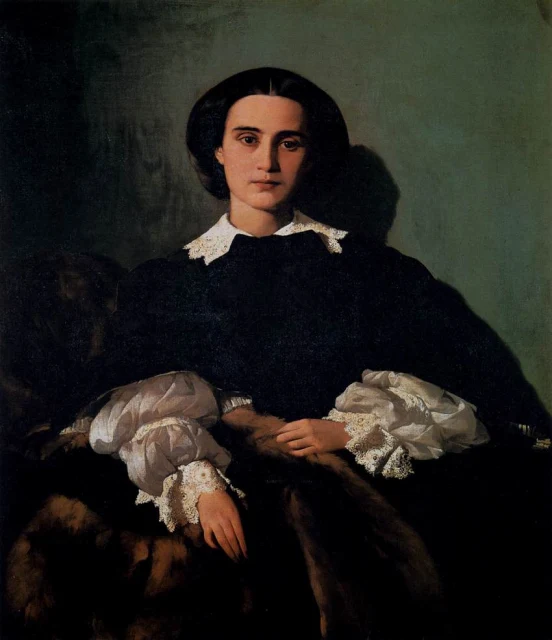
Portraits remained the strongest thing he did. The one at Palazzo Pitti of Signora Morrocchi, painted in the second half of the 1850s, keeps the cool finish of Ingres, whose portraiture Italian painters were studying closely in those years. His output thinned after the 1870s, and he asked to be released from the Bologna chair in 1897, the year he died in Florence at 75.