Antonio Zanchi
1631–1722 · Republic of Venice · Baroque, Tenebrism
The story
In 1666 the Scuola Grande di San Rocco, a rich Venetian confraternity whose halls Tintoretto had covered with paintings a century earlier, gave Antonio Zanchi the right-hand wall of its grand staircase. He was 34. His subject was the plague of 1630, which had killed tens of thousands of Venetians shortly before he was born. He spread it across two enormous canvases, the sick and the dead crowding the lower half in heavy shadow while the Virgin and Saint Roch, the plague saint, plead for the city above. The commission made his name.
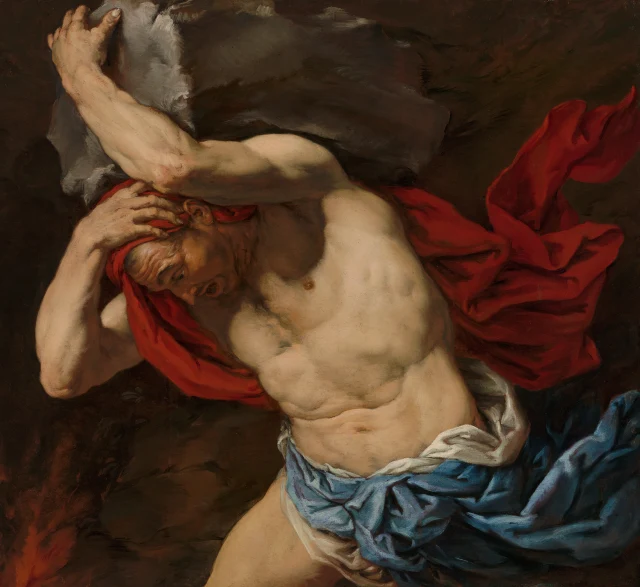
Zanchi came from Este, a small town below the Euganean Hills near Padua, and trained in Venice. He belonged to the painters known as the tenebrosi, the dark ones, who built their pictures from muscular bodies caught in hard light against deep shadow. Work followed across northern Italy, from Bergamo to Verona, and in the 1670s he sent paintings to Munich, for the Bavarian court and the Theatine Church there.
In the 1680s his colours grew warmer and his contrasts softer. In 1703, at 71, he painted a ceiling for the Patriarchal Seminary in Venice, and he died in the city in 1722, at the age of 90.