Arkady Rylov
1870–1939 · Russian Empire, Russian Soviet Federative Socialist Republic, Soviet Union · Realism, Symbolism
The story
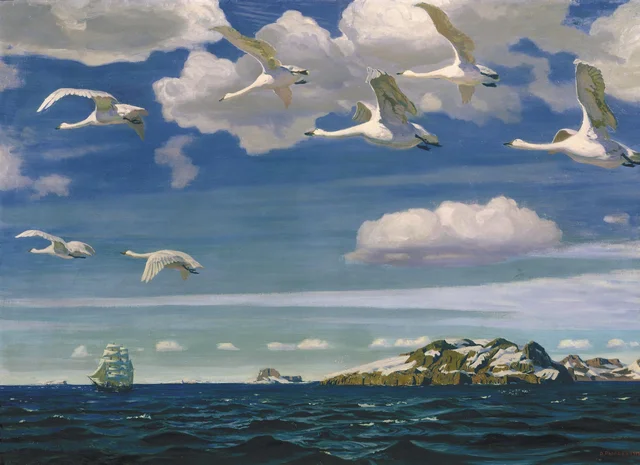
In 1918, in hungry, revolutionary Petrograd, Arkady Rylov painted a flight of white swans over a dark sea under a high blue sky, with a sailing ship and snow-covered rocks on the horizon. In High Azure, now in the Tretyakov Gallery in Moscow, seems to belong to a different world from the city outside his window. Soviet critics later counted it among the works with which the history of Soviet painting is usually said to begin.
Rylov grew up in the Vyatka region in the northeast of European Russia and studied in St Petersburg, first at Baron Stieglitz's school of technical drawing, then at the Imperial Academy of Arts in the studio of Arkhip Kuindzhi, a landscape painter known for his glowing effects of light. Kuindzhi's influence stayed with him, and in later years Rylov chaired the artists' society that bore his teacher's name.
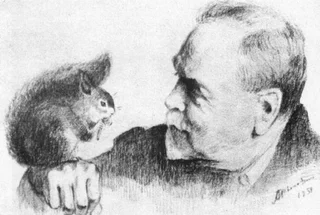
His best-known earlier canvas, The Green Noise of 1904, takes its title from a poem by Nikolai Nekrasov and shows trees tossing in a spring wind above a broad river. He exhibited with the World of Art circle and the Union of Russian Artists, and kept teaching at the Academy after the revolution. Visitors remembered his studio as a small menagerie, where squirrels, rabbits, birds and even a monkey named Manka lived among the canvases. He died in 1939 in Leningrad, as Petrograd had by then been renamed.