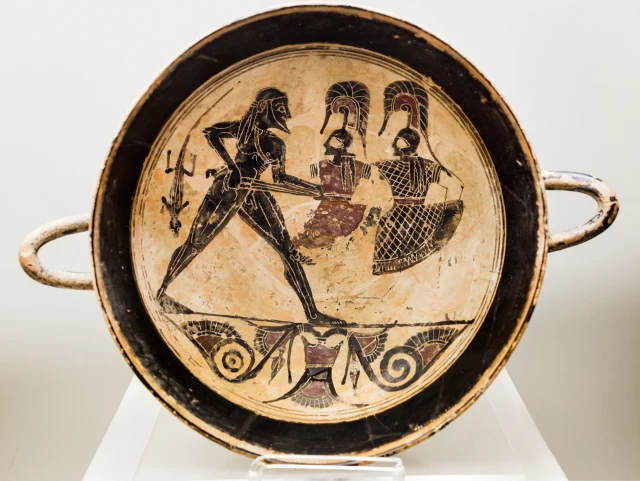
Arkesilas Painter
Ancient Greece · Archaic Greek art
The story
Around 560 BC a painter in Sparta decorated a drinking cup with a scene from across the sea. Under an awning sits Arkesilas the Second, king of Cyrene, the Greek city on the coast of Libya, while his men weigh and pack bales of goods, perhaps silphium, a medicinal plant that made Cyrene rich. That cup, found in an Etruscan tomb at Vulci and now in the Cabinet des Médailles in Paris, gave the painter his modern name.
It also misled scholars for a long time. Pottery of this kind had turned up at Cyrene, and with an African king on one cup and the nymph Kyrene wrestling a lion on another, it was taken to be Cyrenean. British excavations at the sanctuary of Artemis Orthia in Sparta, begun in 1906, showed that it came from Laconia, the territory of Sparta. In 1934 the archaeologist Arthur Lane picked out this painter as one of the first individual hands within it.
He painted mostly cups, with drinking parties and myths, and on one of them the two Titans Atlas and Prometheus are punished side by side, one holding up the sky, the other with an eagle at his liver.