Arthur Segal
1875–1944 · Romania · Constructivism, Expressionism, Cubism
The story
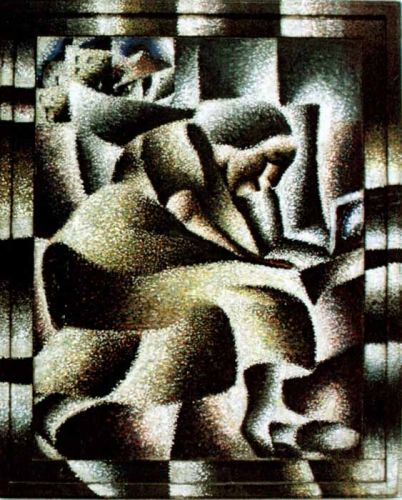
In 1914, as the war began, Arthur Segal took his family from Berlin to Ascona, a lakeside village in southern Switzerland where pacifists, anarchists and vegetarians had gathered around the Monte Verità commune. He stayed until 1920. In nearby Zurich he showed work with the Dadaists at the Cabaret Voltaire, their small club and stage, alongside the artist Hans Arp. In Ascona, brooding on the cruelty of the war, he arrived at the idea that shaped the rest of his painting. He called it equivalence. If no person mattered more than another, then no part of a picture should either, so he divided his canvases into an even grid of fields and gave light, colour and form equal weight in each. In later pictures he often carried the pattern out onto a frame he painted himself.
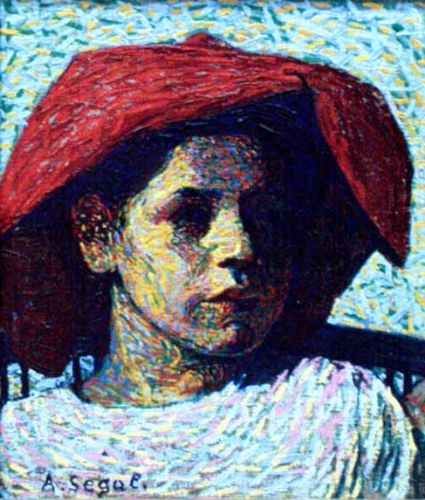
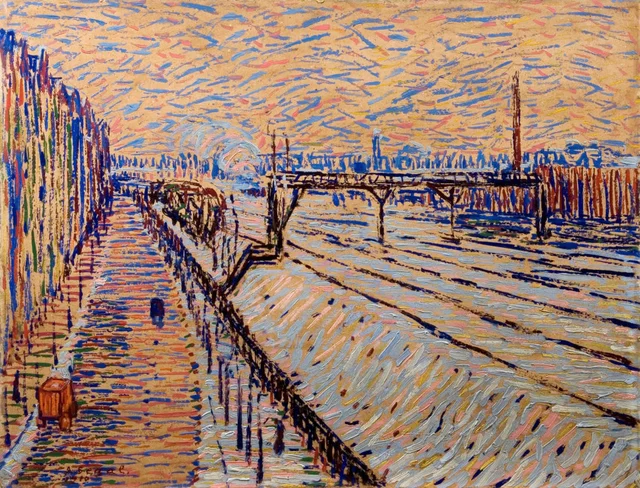
Segal was born in 1875 into a Jewish family in Iași, in Romania, studied in Berlin, Munich, Paris and Italy, and settled in Berlin in 1904. In 1910 he co-founded the New Secession, a group of artists turned away by the established Berlin Secession. The National Museum of Art of Romania in Bucharest holds his Girl with a Red Hat and Railway, both from around 1910.
After the war he ran a painting school in Berlin and declined a post at the Bauhaus, the modern school of art and design. When the Nazis came to power in 1933 he could no longer exhibit in Germany. He moved to Mallorca, then in 1936 to London, where his painting became more naturalistic. In 1937 he opened a painting school there for professionals and amateurs alike, convinced that painting could help people with mental illness. He taught there with his daughter Marianne until his death in London in 1944.