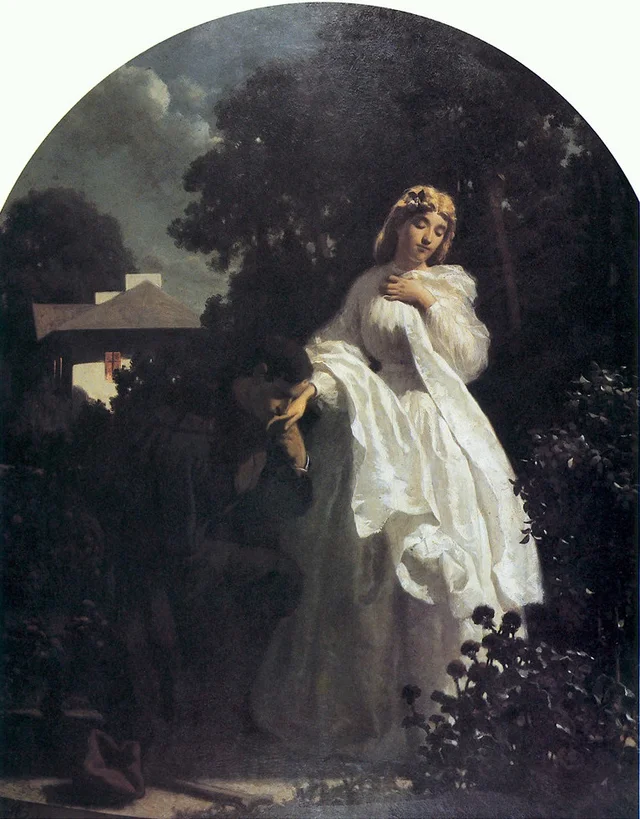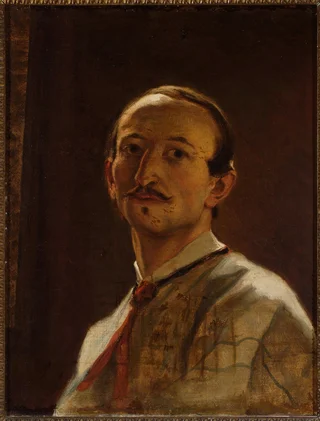
Artur Grottger
1837–1867 · Austrian Empire · Romanticism
The story
Poland did not exist on the map in the 1860s. It had been carved up between Russia, Prussia and Austria for two generations. In January 1863 Poles under Russian rule rose in revolt, and within a year and a half the uprising was crushed, its fighters hanged or marched to Siberia. Artur Grottger never carried a gun in it. He fought it with a pencil.
Working in charcoal from the safety of Austrian Galicia and Vienna, Grottger drew long cycles of scenes, Polonia and Lituania among them, that follow the revolt inside ordinary households: a farewell at a manor door, a widow at a graveside, men dragged from their homes at night. Reproduced as prints, these images crossed the partition borders and taught a stateless nation how to picture its own loss.
He barely outlived the uprising he mourned. Tuberculosis took him in 1867, at 30, in a spa town in the French Pyrenees where he had gone hoping to recover and to earn. His fiancée, Wanda Monné, brought his body back over the mountains for burial in Lwów. The cycles were reproduced for decades and hung in Polish homes long before there was again a Polish state.