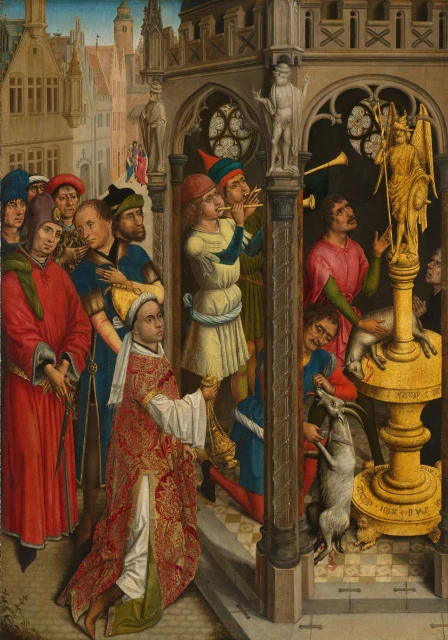
Attributed to Aert van den Bossche
Southern Netherlands · Early Netherlandish painting, Northern Renaissance
The story
Almost everything known about Aert van den Bossche as a painter goes back to one receipt. In 1490 the shoemakers' guild of Brussels paid him for an altarpiece for their chapel in the church of Saint Nicholas, showing the martyrdom of Saints Crispin and Crispinian, the patron saints of shoemakers. That triptych survives, its panels now divided between Warsaw and Brussels, and it is the only work a document ties to his hand.
Every other picture given to him has been matched to that altarpiece by eye, through its bold colours, its lively crowded storytelling and the way the figures are drawn. That is what "attributed to" means on this label. The Rijksmuseum finds the likeness strong enough to use his name, and keeps the qualifier because no contract or payment survives for its panel.
Scholars still debate whether he is the same man as the anonymous Master of the Legend of Saint Barbara, a Brussels painter named after a series of scenes from that saint's life, or one of several hands in that workshop. Beyond the receipt, the archives mention him in Brussels in 1499 and in the Bruges painters' guild a few years later.