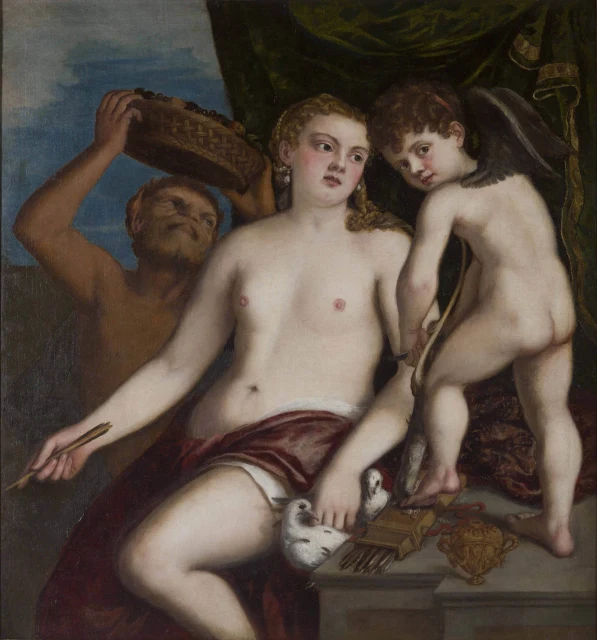
Attributed to Alessandro Varotari
Republic of Venice · Baroque, Venetian school
The story
Anthony van Dyck, the Flemish painter, noted this canvas as a Titian during his stay in Italy around 1622. By the Borghese inventory of 1693 it had become a Paolo Veronese, and in the 20th century Roberto Longhi, the Italian critic, pointed toward Titian's school and perhaps Padovanino. That is the name the Galleria Borghese uses now. The label attributed to marks the hand as probable and unproven, and the museum also allows for his circle.
Alessandro Varotari, called Padovanino after his native Padua, built his career on Titian. He was in Rome between 1614 and 1618, copying Titian's Bacchanals for Cardinal Pietro Aldobrandini, and he absorbed the older master's manner so thoroughly that he could invent new pictures in it. That skill is exactly why a work like this is hard to pin down.
The painting shows Venus seated among doves, holding one of Cupid's arrows while Cupid carves his bow and a satyr lifts a basket of fruit behind them. In the Borghese inventory of 1833 it hung in a room named after its Venuses.