Attributed to Antonio Carracci
Republic of Venice, Papal States · Baroque
The story
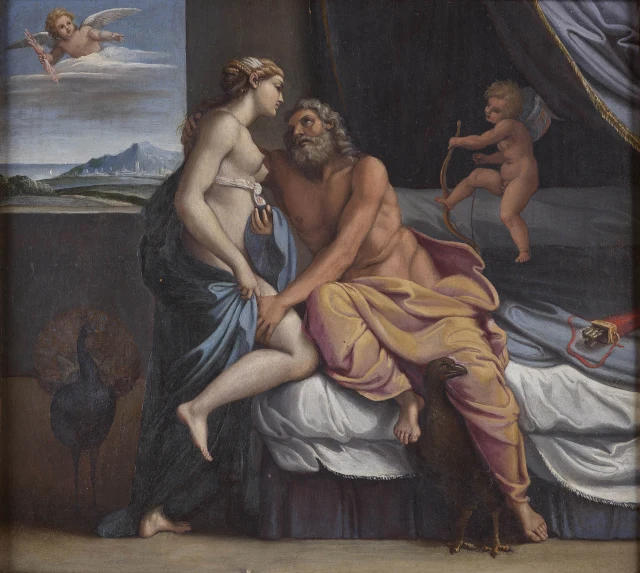
On the vault of the gallery in Palazzo Farnese in Rome, painted by Annibale Carracci between 1597 and 1600, Jupiter and Juno embrace beside a bed in one of the framed scenes. A small panel under this name at the Galleria Borghese repeats that pair and adds a wide view of sea and mountains through the room, a peacock and an eagle for the two gods, and two small cupids.
Antonio Carracci was the illegitimate son of Agostino, Annibale's brother, and he was brought up inside the family studio, working with his uncle in Rome and dying there in 1618 while still young. Attributed to is how a museum leans towards a hand without proof. For this panel the argument has run through three names. Tradition gave it to Annibale, the scholar Luigi Salerno proposed Antonio in 1956, and in 1981 Giovanni Antonio Solari, a little-known member of the Carracci workshop, was suggested. The museum dates it to about 1612, and it first appears in the Borghese inventory of 1762 as a picture of Jupiter with a woman.