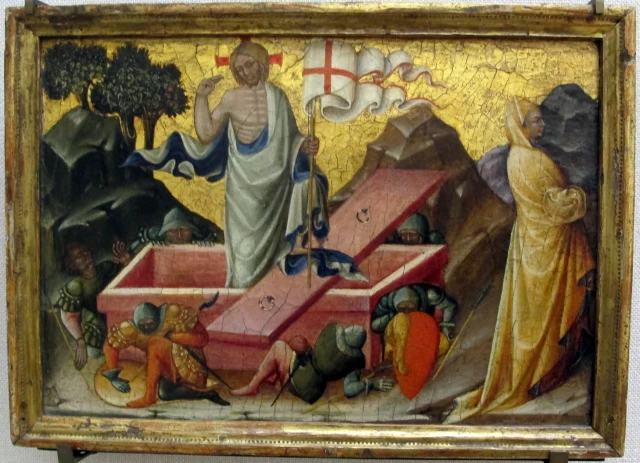
Attributed to Bartolomeo di Tommaso
Papal States · International Gothic
The story
Attributed to is the museum's way of saying that a picture looks like the work of a named painter, while no signature, contract or document confirms it. The Louvre uses the formula for a small panel, a Resurrection, which it gives with that hedge to Bartolomeo di Tommaso.
Bartolomeo came from Foligno, in Umbria, and by 1425 he was living in Ancona, on the Adriatic coast, working through the 1430s for towns of the Marches such as Fano. Italian scholarship describes his manner as the last and most extreme phase of International Gothic, the ornate court style of around 1400, with little interest in the new Florentine perspective. In 1451 Pope Nicholas V paid him seven ducats a month for paintings in the Vatican palace. His best-known surviving work came soon after, a Last Judgement with hell, purgatory and paradise in the Paradisi family chapel of San Francesco in Terni.