Attributed to Friedrich Carl Albert Schreuel
Dutch Republic, Kingdom of Saxony · Neoclassicism, Portrait miniature
The story
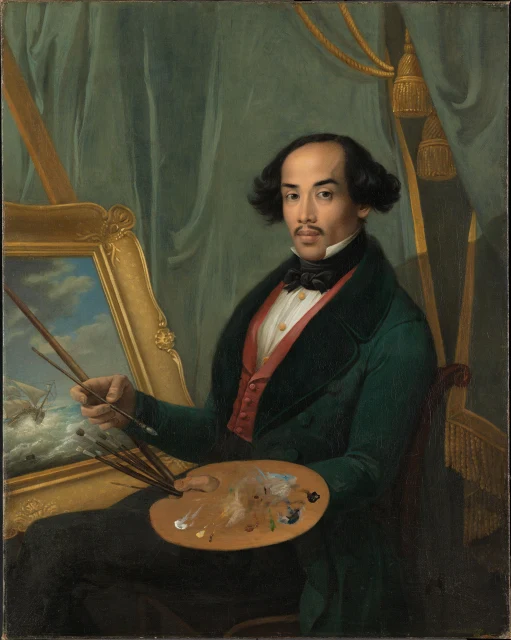
The painting behind this name shows the Javanese painter Raden Saleh seated before a seascape, holding his palette, brushes and maulstick. For a long time it was taken to be his self-portrait, and as late as 2005 the Rijksmuseum, which bought it in 1978, still called it one. The museum now lists it as attributed to Friedrich Carl Albert Schreuel. That means Schreuel is judged the likely painter, while no signature or document proves it. The pose of an artist at work, usual in self-portraits, is one reason the older reading lasted so long.
Schreuel was born in Maastricht in 1773 and served in the Dutch army as a young man. From 1805 he worked in Dresden, trained under Josef Grassi, the portraitist who taught at the Dresden Academy, and made his name with portrait miniatures. By 1840 the King of Saxony had made him a professor of painting. Saleh reached Dresden in 1839, and the portrait dates from about 1840. It is first recorded at an exhibition of the Dresden Academy, where it was well received.
Saleh's years in Europe were themselves a colonial arrangement. He came from a family of Javanese regents, the local rulers who governed for the Dutch administration, and arrived in the Netherlands in 1829 to study painting, on a stipend charged to the Ministry of the Colonies. There he trained with the portrait painter Cornelis Kruseman and with Andreas Schelfhout, a painter of landscapes and sea views. The Rijksmuseum describes him in this picture as a European dandy before a Western seascape. Later he specialised in scenes of the East and dressed as a Javanese prince, and after his return to Java he built a neo-Gothic palace where he received European visitors.