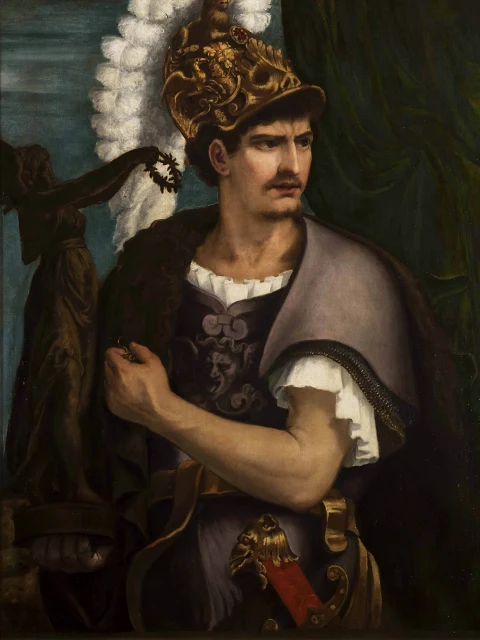
Attributed to Giuseppe Cesari
Kingdom of Naples · Mannerism
The story
A young warrior in a golden helmet with a white plume, a lion skin over his armour in homage to Hercules, holds a small statue of Victory who offers him a laurel crown. He is Alexander the Great, and the model is a painting by Giulio Romano, Raphael's leading pupil, made for the court of Mantua around 1537 and now in the Musée d'art et d'histoire in Geneva.
The name on this Borghese version comes from the inventory of 1790, which lists a warrior by the Cavalier d'Arpino. Giuseppe Cesari, known by that title, was one of the most sought-after painters in Rome around 1600, and the young Caravaggio worked in his studio. In 1607 his collection was confiscated by the papal treasury, and much of it passed to Cardinal Scipione Borghese, the pope's nephew. The museum keeps his name with attributed to because it stands on that old inventory, while part of the criticism, Roberto Longhi among them, prefers a northern Italian painter of the mid-16th century.
Between 1939 and 1945 the canvas decorated the Roman villa of Marshal Pietro Badoglio, the Italian army commander, before it returned to the gallery.