Attributed to Sultan Muhammad
Safavid Iran · Persian miniature, Safavid art, Tabriz School
The story
In 1522 a boy of eight came back to Tabriz from Herat, the old Timurid capital in the east where he had been sent as a child governor, and two years later he was shah of Iran. Tahmasp had learned to paint out there, and the man who went on teaching him at home was Sultan Muhammad, a Tabriz painter who ran the kitabkhana, the royal book workshop where calligraphers, illuminators, gilders and binders worked on the same volume for years at a time. He had grown up in the older Turkman style of the city and absorbed the finer manner that came west with the painters from Herat.
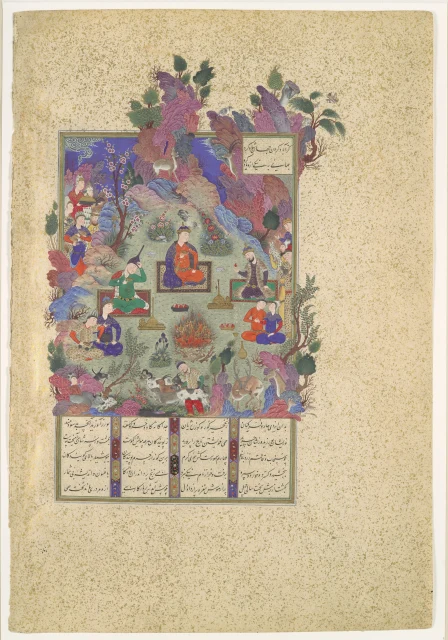
The workshop's largest job was a Shahnama, Firdausi's Book of Kings, made for Tahmasp with some 258 paintings. The Feast of Sada, painted around 1525, shows the moment fire is discovered. The first king, Hushang, throws a stone at a snake, misses, strikes rock, and the sparks that fly become a feast that Iran kept celebrating. The court sits on a slope of pink and purple rock, and if you follow the rocks you find faces and figures hidden in them, along with cows and a braying donkey pushing in at the lower left.
None of it is signed. What we know about who painted which folio comes mostly from a preface written in 1544 by Dust Muhammad, a painter and album compiler, who names Sultan Muhammad and singles out one page, The Court of Gayumars, for extraordinary praise. Everything else, this folio included, is attribution. No birth or death year is recorded for him. He was at work by about 1500 and gone by the mid 1550s, by which time Tahmasp had turned away from painting altogether. In 1568 the shah sent the finished book to the Ottoman sultan in Istanbul as a gift.