Attributed to Zanobi Strozzi
Republic of Florence · Early Renaissance, Florentine school
The story
Panels in the National Gallery in London stand behind this name, and the museum labels them probably by Zanobi Strozzi. The words attributed to carry the same caution here. Strozzi came from a well-off Florentine family and worked mostly as an illuminator of manuscripts. Only one panel survives with his name on it, an Annunciation in the same gallery, where ZANOBI is hidden in the gold pattern along the Virgin's cloak. Everything else is judged by comparison with that picture and with his books.
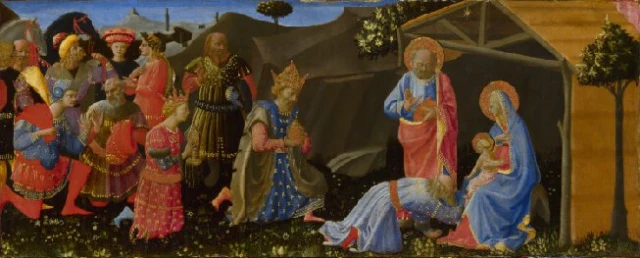
One, from about 1433, is a narrow strip from the base of an altarpiece. Three crowned kings kneel before the Child, and one of them bends to kiss his foot. The Virgin's gesture is close to one in a tabernacle Fra Angelico, the Dominican friar and painter whom Strozzi followed closely, made for the linen merchants' guild in the same year. Technical study has shown that a Nativity now in the Metropolitan Museum in New York was painted on the same piece of wood.
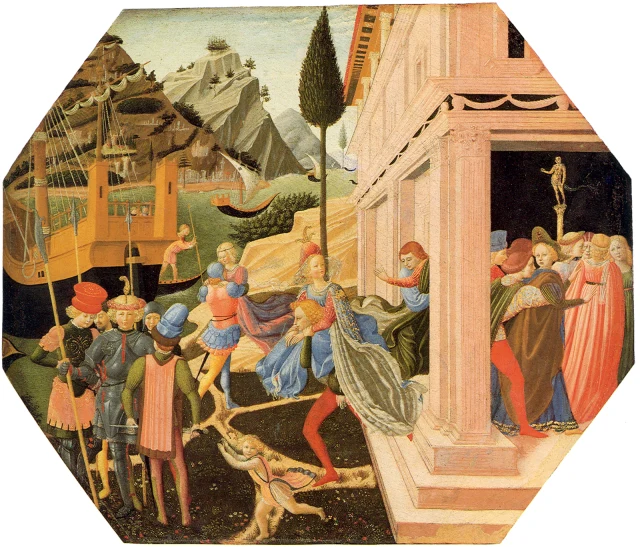
Another, from about 1450, is a birth tray, the painted wooden tray Florentine families gave to celebrate a pregnancy or a birth. Paris, the Trojan prince, waits in armour while Helen, marked by three feathers in her hat, is carried on a young man's shoulders towards a boat. The pink palace beside them appears to copy the architect Alberti's design for the Palazzo Rucellai in Florence. The Encyclopaedia Britannica of 1911 still listed this tray among the works of Benozzo Gozzoli, calling it doubtful even then. Both panels were bought by the National Gallery in 1857 from the Lombardi-Baldi collection in Florence.