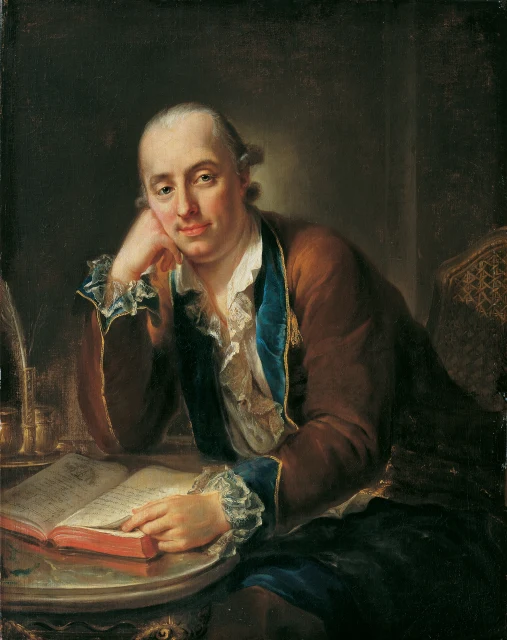
August Friedrich Oelenhainz
1745–1804 · Holy Roman Empire · Neoclassicism
The story
In 1770 a young painter from Württemberg portrayed Johann Nepomuk von Humbourg, whom his early biographer describes as physician to Empress Maria Theresa, and signed his own name in large letters across the open book lying before the sitter. August Friedrich Oelenhainz was about 25. The portrait, now in the Belvedere, is one of his first independent works and still leans on the older German manner of the early 18th century.
Oelenhainz was a pastor's son from Endingen, sent to Tübingen to study theology until a relative who painted portraits drew him to art. He trained in Stuttgart, came to Vienna in the mid-1760s and studied at its academy, then made a career portraying the city's aristocracy, among them the Schwarzenberg princes, and its writers, such as the poet Alois Blumauer. He became a member of the Imperial Academy and joined the Freemasons, whose Vienna lodges of the 1780s also counted Mozart and Haydn as members.
In the early 1790s he moved to Switzerland and worked in Zurich and Bern, and later he spent more than a year in Paris. In November 1804, already unwell, he took the stagecoach home toward Stuttgart. At about two in the morning it stopped at the Golden Ox inn in the French fortress town of Phalsbourg, and minutes after stepping down he died of a stroke. His biographer, writing about a century later, could find no trace of his grave.