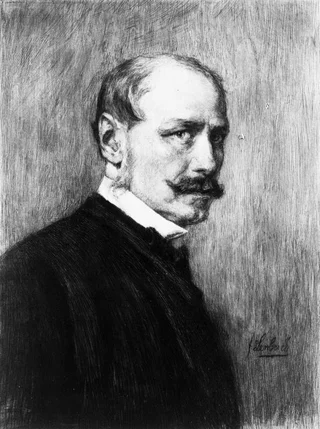
August von Pettenkofen
1822–1889 · Austrian Empire, Austria–Hungary · Realism
The story
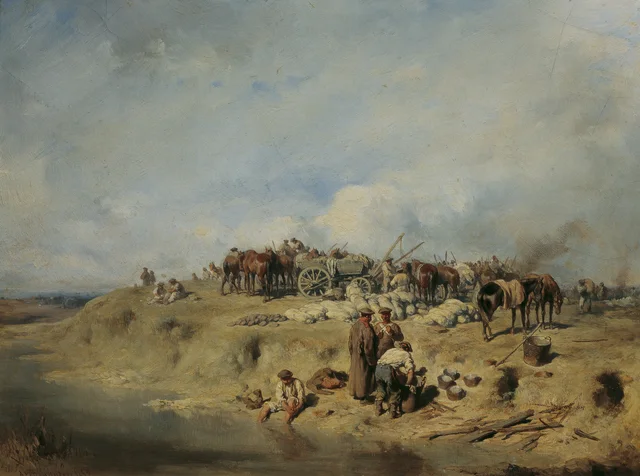
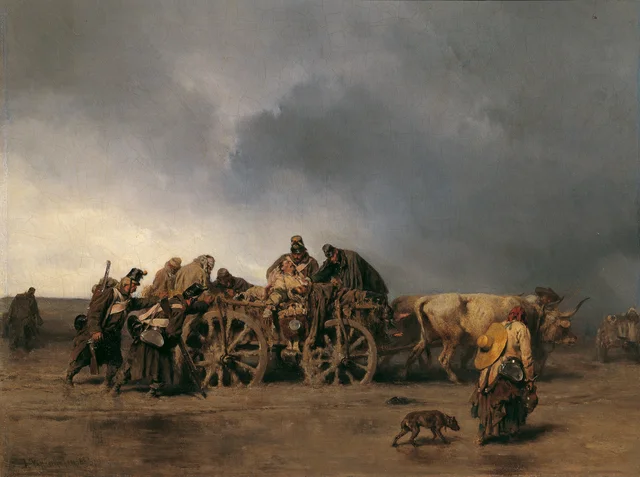
For about 30 years from 1851, August von Pettenkofen kept going back to the same small town on the Hungarian plain. Szolnok, on the river Tisza, had a dusty market square, peasant carts, horses led down to the water and a hard summer light, and he painted them again and again, in small pictures with a muted, greyish tone.
He was Viennese, born in 1822, and trained at the Vienna Academy in the gentle genre manner of the Biedermeier years. People who knew him described him as shy. In 1852 he went to Paris and came into contact with the Barbizon painters, landscape artists who worked directly from nature in the forest outside the city, and their attention to air and daylight went with him back to the plain. In the 1870s he also travelled to Venice almost every year.
The Szolnok pictures found buyers far away. In 1878 the Baltimore collector William T. Walters acquired one of his market scenes. In Hungary the young painters Lajos Deák-Ébner and Gyula Aggházy followed him to the town, Deák-Ébner spending every summer there from 1875 to 1887, and their visits count as the first chapter of what became the Szolnok artists' colony. Pettenkofen was knighted in 1876 and died in Vienna in 1889.