Balchand
Mughal Empire
The story
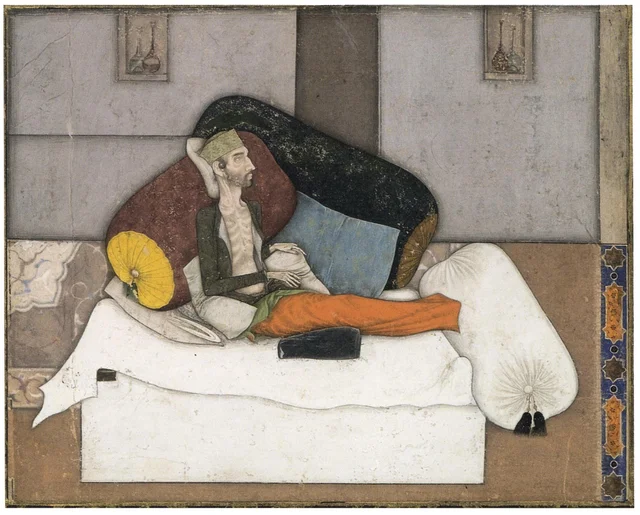
In October 1618, Inayat Khan, a courtier close to the Mughal emperor Jahangir, lay dying, wasted by years of opium and wine. Jahangir had him brought before him and, shocked by how thin he had become, ordered his painters to record his likeness. The result is one of the most unsparing images in Mughal art, a skeletal man propped up on cushions. It is now in the Bodleian Library in Oxford. An inscription calls it the work of Balchand, servant of the court, and the preparatory drawing survives in the Museum of Fine Arts, Boston.
Balchand was a Hindu painter in the imperial workshop, active from about 1595 to about 1650, a span that runs from the last years of the emperor Akbar through the reign of Shah Jahan. His brother Payag was also a court painter, and both are known for a sober, close-up realism. Balchand also painted scenes for the Padshahnama, the illustrated official chronicle of Shah Jahan's reign, now in the Royal Collection at Windsor.