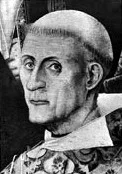
Bernt Notke
1435–1509 · Holy Roman Empire · Late Gothic, Northern European Gothic
The story
In 1471 the Swedish regent Sten Sture the Elder beat a Danish army at Brunkeberg, on the ridge where Stockholm now climbs, and before the fight he had placed his soldiers under the protection of Saint George. To thank the saint he ordered a monument, and the commission went to Bernt Notke, the leading artist of the whole Baltic world.
What Notke delivered, finished in 1489 and still standing in Stockholm's Great Church, is one of the strangest sculptures of the northern Middle Ages: a life-size knight on a rearing horse driving his lance into a spiny dragon, carved in oak and set with real elk antler for the beast's spines. The horse wears Sten Sture's own coat of arms, so the whole group reads as Sweden trampling Denmark.
Notke ran a large workshop in Lübeck, the merchant city that anchored the Hanseatic trade network, and his hand or his designs turned up all across the region. He is credited with the great Dance of Death paintings in Lübeck and in Tallinn, where a long fragment survives, a row of the living led off by grinning skeletons. He died in 1509, back in Lübeck, an old man who had outlived most of the patrons who made him.
